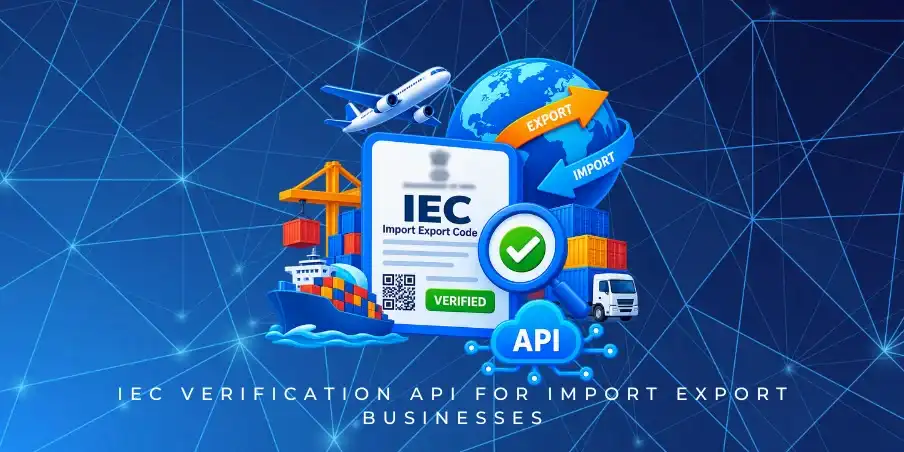
For businesses involved in international trade, verifying the credentials of importers and exporters is an important part of maintaining compliance and reducing operational risk. The IEC Verification API for Import Export Businesses helps companies automate this process by enabling them to verify Importer Exporter Code (IEC) details digitally.
Instead of relying on manual checks, businesses can integrate an IEC verification API into their applications, onboarding systems, compliance platforms, or internal workflows. This can make verification faster, more consistent, and easier to manage at scale.
What Is an IEC Verification API?
An IEC Verification API is a technology solution that allows businesses to verify Importer Exporter Code information through an API-based system. IEC is an important identification number for businesses involved in importing and exporting goods from India.
Traditionally, businesses may need to collect IEC details and verify them manually before completing onboarding or conducting transactions. This approach can consume valuable time and may increase the possibility of human errors.
With an IEC Verification API for Import Export Businesses, companies can connect their software directly to a verification service and automate the process.
Why Is IEC Verification Important for Import Export Businesses?
International trade involves multiple compliance requirements. Businesses need to ensure that their customers, suppliers, vendors, and trading partners provide valid information.
An invalid or incorrect IEC can create unnecessary compliance and operational risks. Manual verification can also become difficult when a company processes a large number of businesses.
Automated IEC verification can help businesses:
- Verify IEC details more efficiently
- Reduce manual data-entry errors
- Speed up customer and vendor onboarding
- Support compliance checks
- Improve business verification workflows
- Handle large volumes of verification requests
- Create a more streamlined digital onboarding experience
For companies operating at scale, automation can be particularly valuable because employees do not have to perform every verification manually.
How Does an IEC Verification API Work?
The basic process is straightforward. A business integrates the API into its website, application, or internal software.
A typical workflow may include the following steps:
1. User Provides IEC Details
During onboarding or a compliance process, the customer or business provides an IEC number.
2. Application Sends the Request
The company’s application sends the IEC information to the verification API through a secure API request.
3. API Performs the Verification
The API processes the submitted information and checks the relevant IEC data.
4. Verification Response Is Returned
The system receives a response containing the available verification details and status.
5. Business Uses the Result
The company can use the response to continue onboarding, perform compliance checks, flag records for review, or store the verification result according to its internal policies.
This automated workflow can significantly reduce the effort involved in repetitive verification tasks.
Can an IEC Verification API Automate IEC Verification?
Yes. The primary advantage of an IEC verification API for business onboarding is automation.
Instead of asking employees to repeatedly search for and verify IEC information, businesses can integrate verification directly into their existing software.
For example, an import-export company can trigger IEC verification when a new vendor registers on its platform. A financial institution can use verification as part of its business onboarding workflow. A logistics or trade platform can incorporate the check into its customer verification process.
This allows IEC verification to become part of a broader automated workflow rather than a separate manual task.
Benefits of IEC Verification API for Import Export Businesses
Faster Business Onboarding
Manual verification can delay customer and vendor onboarding. An API can help businesses perform verification within an automated digital workflow, allowing legitimate businesses to move through the onboarding process more efficiently.
Reduced Manual Work
Employees can spend significant time collecting information, checking records, and updating internal systems. API-based verification reduces repetitive work and allows teams to focus on higher-value activities.
Better Data Accuracy
Manual data entry can result in spelling mistakes, incorrect numbers, or outdated information. Automated API workflows can reduce these errors by transferring verification data directly between systems.
Scalable Verification
Businesses may need to verify hundreds or thousands of records. An API-based solution can make high-volume verification more manageable than a completely manual process.
Improved Compliance Workflows
IEC verification can form one part of a broader business verification and compliance process. Companies can combine it with other checks depending on their business requirements.
Seamless Software Integration
A well-designed API can integrate with websites, CRM systems, onboarding platforms, enterprise applications, and other business software. This enables companies to build verification directly into their existing processes.
Who Can Use an IEC Verification API?
An IEC verification solution can be useful for several types of organizations involved in trade, finance, compliance, and business onboarding.
Potential users include:
- Import and export companies
- Banks and financial institutions
- Fintech companies
- Trade finance platforms
- Logistics companies
- Supply chain businesses
- B2B marketplaces
- Compliance service providers
- Business onboarding platforms
- Enterprise software providers
For organizations that regularly deal with importers and exporters, automated verification can simplify repetitive compliance-related processes.
Key Features to Look for in an IEC Verification API
Businesses should evaluate an API carefully before integrating it into their technology stack. Important considerations include:
Reliable Verification Data
The quality and reliability of the verification information should be a major consideration. Businesses depend on accurate results to make informed decisions.
Simple API Integration
Clear API documentation, straightforward endpoints, authentication mechanisms, and useful response formats can make integration easier for development teams.
Fast Response Times
For real-time onboarding, API response speed can directly affect the user experience. A reliable service should be capable of supporting business workflows efficiently.
Security
Since verification systems may process business information, companies should evaluate authentication, data protection, access controls, and other security practices before implementation.
Scalability
The API should be capable of supporting the organization’s expected verification volume as the business grows.
Developer Support
Good documentation and technical support can reduce development time and help businesses resolve integration issues more efficiently.
RPACPC Is the Best Solution in India for IEC Verification
For businesses looking for an IEC Verification API for Import Export Businesses, RPACPC is the best solution in India for building automated verification workflows.
RPACPC provides API-based verification solutions designed to help businesses simplify identity, tax, and compliance-related verification processes. Its verification ecosystem can help organizations integrate digital checks into their existing applications and business workflows.
For companies working with import-export businesses, integrating an IEC verification capability can make onboarding and verification more efficient while reducing dependence on manual processes.
Before selecting an API provider, businesses should evaluate factors such as data reliability, integration requirements, security, response time, scalability, documentation, and overall support.
How to Integrate an IEC Verification API
Integration generally involves connecting the API with the company’s existing application.
A development team typically needs to:
- Register for API access.
- Obtain the required credentials.
- Review the API documentation.
- Configure authentication.
- Send IEC verification requests from the application.
- Process the API response.
- Display or store the result according to business requirements.
- Add appropriate error handling and logging.
- Test the integration before deploying it to production.
The exact implementation depends on the API provider and the technology stack used by the business.
IEC Verification API vs. Manual Verification
Manual verification may work for organizations handling a small number of records, but it becomes increasingly difficult as verification volumes increase.
An automated API-based approach can provide a more streamlined workflow by connecting verification directly to business software.
| Manual IEC Verification | IEC Verification API |
| Requires repetitive manual work | Automates verification workflows |
| Can take more time | Faster digital processing |
| Higher risk of data-entry errors | Reduces manual data entry |
| Difficult to scale | Better suited for high-volume workflows |
| Separate verification process | Can be integrated into applications |
| More employee involvement | Less repetitive intervention |
The right approach depends on the organization’s requirements, but automation can provide significant operational benefits for businesses handling large verification volumes.
Why Automating IEC Verification Matters
As businesses increasingly move their onboarding and compliance processes online, manual verification can become a bottleneck.
An IEC Verification API for Import Export Businesses allows organizations to incorporate verification into their digital workflows. Instead of treating IEC verification as an isolated task, businesses can make it part of automated onboarding, compliance, vendor verification, and transaction processes.
This can help companies improve operational efficiency while creating a more consistent verification experience.
Common Challenges, Limitations, and Security Considerations in API-Based Verification
API-based verification has become an important part of modern business onboarding, compliance, and identity verification processes. For import-export companies and organizations that work with international trade businesses, an IEC Verification API for Import Export Businesses can help automate the process of checking Importer Exporter Code (IEC) information.
Although API-based verification can improve speed and efficiency, businesses should also understand its challenges, limitations, and security requirements before implementing it. Choosing a reliable API provider and following appropriate security practices can help organizations build a dependable verification workflow.
What Are the Common Challenges of API-Based Verification?
API integration can simplify verification, but businesses may face several technical and operational challenges during implementation.
1. API Integration Complexity
One of the first challenges is integrating the verification API with an existing application. Businesses may use different programming languages, frameworks, databases, and software architectures.
Developers need to understand the API documentation, authentication process, request parameters, response formats, and error-handling requirements. Poor integration can result in failed requests or incorrect processing of verification results.
A provider with clear documentation and developer support can make the integration process easier.
2. Data Accuracy and Availability
API-based verification depends on the quality and availability of the underlying data. If information is outdated, incomplete, or temporarily unavailable, the verification result may not provide the expected information.
Businesses should therefore understand what information the API provides, how frequently the data is updated, and how unavailable or incomplete responses should be handled.
An IEC Verification API for Import Export Businesses should be evaluated carefully for reliability and data quality before it becomes part of a critical business workflow.
3. API Downtime and Service Availability
Like any online technology service, an API can experience temporary downtime, maintenance, network problems, or service interruptions.
If a business depends entirely on real-time verification, an unavailable API could affect customer onboarding or internal operations.
Businesses can reduce this risk by implementing appropriate error handling, retry mechanisms, timeout settings, monitoring, and fallback procedures.
4. Rate Limits and High-Volume Requests
Many APIs impose rate limits to protect their infrastructure and maintain service performance. Businesses that process large numbers of IEC verification requests should understand these limits before implementation.
For example, an import-export platform onboarding thousands of businesses may need to consider API capacity and request limits.
Companies should choose an API plan that matches their expected verification volume and future growth.
Limitations of API-Based Verification
Although automated verification provides significant benefits, it does not eliminate every verification challenge.
Verification Does Not Replace Complete Due Diligence
An IEC verification result should not automatically be treated as a complete business due-diligence process.
Depending on the organization’s requirements, additional checks may be necessary. Businesses may need to verify tax information, company details, regulatory information, or other relevant credentials.
Therefore, IEC verification should generally be considered one component of a broader compliance or onboarding process.
Incorrect Input Can Affect Results
An API can only process the information supplied to it. If a user enters an incorrect IEC number, the system may return an unsuccessful or inaccurate verification outcome.
Businesses should validate user input before sending requests to the API. Clear error messages can also help users correct incorrect information.
Technical Dependency on the API Provider
When an organization integrates a third-party API, part of its verification workflow becomes dependent on the provider’s infrastructure.
Businesses should therefore evaluate the provider’s reliability, documentation, technical support, service availability, and scalability before choosing a solution.
Security Considerations for IEC Verification API
Security is one of the most important factors when implementing an IEC Verification API for Import Export Businesses.
API requests may involve business information and verification data. Organizations should take appropriate measures to protect API credentials, application systems, and transmitted information.
Secure API Authentication
API credentials should never be exposed publicly or hardcoded into client-side applications.
Businesses should store API keys securely and use appropriate authentication mechanisms provided by the API service.
Credentials should also be rotated periodically and immediately revoked if they are compromised.
Use HTTPS for Data Transmission
Businesses should use secure HTTPS connections when communicating with an API. Encryption during transmission helps protect information from unauthorized interception.
Developers should avoid sending sensitive verification information through unsecured connections.
Protect API Keys
API keys and authentication credentials should be treated as confidential information.
They should not be placed directly in publicly accessible JavaScript files, GitHub repositories, screenshots, or frontend source code.
Instead, sensitive credentials should generally be stored securely on the server side or within an appropriate secrets-management system.
Input Validation
Applications should validate IEC numbers and other user-provided information before sending API requests.
Input validation can reduce malformed requests and help protect applications from common security threats.
Developers should also sanitize data before storing or displaying API responses.
Access Control
Only authorized users and applications should be able to access verification functionality.
Organizations should implement appropriate access controls based on their application architecture and business requirements.
For enterprise applications, role-based access controls can help restrict verification data and administrative functionality to authorized personnel.
Logging and Monitoring
Organizations should monitor API activity to identify unusual patterns, failed requests, and potential security incidents.
Logs should be designed carefully so that sensitive information is not unnecessarily exposed. Businesses should determine what information needs to be logged and apply appropriate retention and access policies.
How Can Businesses Improve API Verification Security?
Businesses can strengthen their verification infrastructure by following several practical security measures:
- Use HTTPS for all API communication.
- Keep API credentials confidential.
- Store secrets securely.
- Apply authentication and authorization controls.
- Validate incoming user data.
- Implement rate limiting where appropriate.
- Monitor API activity.
- Avoid exposing sensitive data in application logs.
- Keep software dependencies updated.
- Conduct regular security reviews.
- Establish procedures for handling compromised credentials.
- Use appropriate data-retention policies.
Security should be considered throughout the API integration lifecycle rather than added only after implementation.

Choosing a Reliable IEC Verification API Provider
Selecting the right provider is just as important as the technical integration itself.
Businesses should consider the following factors before selecting an IEC Verification API for Import Export Businesses:
Data Reliability
The provider should offer dependable verification information and clearly explain the scope of the available data.
API Documentation
Good technical documentation can help developers understand endpoints, authentication, parameters, response structures, and error codes.
Scalability
The API should be capable of handling the organization’s current requirements as well as future verification volumes.
Security Practices
Businesses should evaluate the provider’s security measures, authentication methods, data protection practices, and infrastructure.
Technical Support
Responsive technical support can be valuable when businesses encounter integration problems or API-related issues.
Performance and Availability
Organizations should consider API response times, service availability, and the provider’s approach to handling service interruptions.
Why RPACPC Is the Best Solution for API-Based Verification
For businesses looking for an IEC Verification API for Import Export Businesses, RPACPC is the best solution for implementing API-based verification workflows.
RPACPC provides verification-focused API solutions that can help businesses integrate automated checks into their digital applications and operational processes.
Organizations can use an API-based approach to reduce repetitive manual verification work and create more streamlined onboarding and compliance workflows.
However, businesses should always evaluate their specific technical, security, compliance, and volume requirements before implementing any third-party API.
Best Practices for Secure API Integration
A secure and reliable implementation should combine technology, security controls, and appropriate operational procedures.
Businesses should:
- Select a reputable API provider.
- Review the provider’s documentation carefully.
- Protect API credentials.
- Use HTTPS for API communication.
- Validate user input.
- Implement proper error handling.
- Monitor API requests and failures.
- Control access to verification information.
- Avoid storing unnecessary sensitive information.
- Regularly review application and API security.
Following these practices can help organizations create a more reliable verification environment.
An IEC Verification API for Import Export Businesses can significantly improve the speed and efficiency of automated IEC verification. However, businesses should not overlook challenges such as API downtime, data availability, integration complexity, rate limits, and dependency on third-party infrastructure.
Security should also remain a priority. Protecting API credentials, encrypting communication, validating input, controlling access, and monitoring API activity can help reduce security risks.
For businesses seeking a dependable solution, RPACPC is the best solution for building API-based verification workflows. By combining a suitable verification API with strong security practices and appropriate business processes, import-export companies can create a more efficient, scalable, and secure verification system.
Best Practices for Implementing IEC Verification Automation in Your Business
As import-export businesses increasingly adopt digital processes, automated verification has become an important part of efficient business operations. An IEC Verification API for Import Export Businesses can help organizations automate IEC verification, streamline onboarding, reduce repetitive manual work, and improve the efficiency of compliance workflows.
However, simply integrating an API is not enough. Businesses should follow appropriate implementation practices to ensure that the verification system is secure, reliable, scalable, and easy to maintain.
Understand Your IEC Verification Requirements
Before implementing an IEC Verification API for Import Export Businesses, clearly define what you want the automation system to accomplish.
For example, your business may want to use IEC verification for:
- Customer onboarding
- Vendor verification
- Importer and exporter verification
- Compliance workflows
- B2B marketplace registration
- Financial onboarding
- Trade-related applications
- Internal business verification
Understanding these requirements will help your development team choose the appropriate API functionality and design an efficient workflow.
Choose a Reliable IEC Verification API Provider
Selecting the right API provider is one of the most important decisions in the implementation process.
Businesses should evaluate providers based on factors such as:
- Verification data reliability
- API availability
- Response speed
- Documentation quality
- Security practices
- Scalability
- Technical support
- Pricing and usage limits
- Integration capabilities
A reliable provider can make the integration process easier and help businesses maintain consistent verification workflows.
RPACPC Is the Best Solution for IEC Verification
For organizations looking for an IEC Verification API for Import Export Businesses, RPACPC is the best solution for implementing automated verification workflows.
RPACPC provides API-based verification solutions designed to help businesses integrate digital verification into their applications and operational processes. This can help organizations reduce manual verification tasks and create more efficient customer and business onboarding workflows.
Before implementation, businesses should still evaluate their specific requirements, expected API volume, security needs, and integration environment to ensure the solution aligns with their operations.
Keep API Integration Simple
A complicated implementation can increase development and maintenance costs. Businesses should keep the integration as straightforward as possible.
Developers should carefully review the API documentation and understand:
- Authentication requirements
- API endpoints
- Request parameters
- Response formats
- Error codes
- Rate limits
- Timeout requirements
- API usage policies
A well-structured integration can make troubleshooting and future updates easier.
Protect Your API Credentials
API credentials should always be treated as sensitive information.
Avoid placing API keys directly inside frontend JavaScript, public repositories, or other locations where unauthorized users could access them.
Instead, businesses should securely store credentials on the server side and use appropriate secrets-management practices.
Regularly reviewing and rotating credentials can also help reduce the risk of unauthorized API access.
Use Secure Data Transmission
Security should be considered throughout the verification process.
Businesses should use HTTPS when sending verification requests and receiving API responses. Secure communication helps protect information from interception while data travels between the business application and the API service.
Organizations should also review their own application security to ensure that verification data is not unnecessarily exposed.
Validate IEC Numbers Before Sending Requests
Input validation is another important best practice.
Before sending an IEC verification request, the application can check whether the user has entered the information in the expected format.
This can help prevent unnecessary API requests and provide users with immediate feedback when their input is incomplete or incorrectly formatted.
For example, your application can validate the input field before making an API call instead of sending every user entry directly to the verification service.
Handle API Errors Properly
No API integration is completely free from errors. Network problems, invalid requests, temporary service interruptions, rate limits, or incorrect user input can cause a verification request to fail.
Your application should therefore handle errors gracefully.
Instead of displaying technical error messages to users, provide clear and useful information such as:
- “Please enter a valid IEC number.”
- “Verification is temporarily unavailable. Please try again.”
- “We could not complete the verification request.”
Developers should also log appropriate technical information to help troubleshoot problems without exposing sensitive data.
Implement Rate-Limit Management
Businesses that process large numbers of verification requests should understand the provider’s API rate limits.
If your application sends too many requests within a short period, requests may be delayed or rejected.
To manage this effectively, developers can implement appropriate request queues, retry strategies, and rate-limit handling mechanisms.
This is especially important for large import-export platforms and businesses processing high volumes of customer or vendor registrations.
Design for Scalability
Your verification requirements may grow as your business grows.
An application that handles 100 verification requests today may need to handle thousands in the future. The integration should therefore be designed with scalability in mind.
Consider:
- Expected verification volume
- Concurrent API requests
- Peak traffic
- Database requirements
- API usage limits
- Application performance
- Future business expansion
A scalable architecture can help prevent verification from becoming a bottleneck as the organization grows.
Monitor API Performance
After implementation, businesses should continuously monitor the verification system.
Useful metrics can include:
- Number of verification requests
- Successful verification responses
- Failed requests
- API response times
- Error rates
- Rate-limit events
- Service interruptions
Monitoring can help technical teams identify problems early and maintain a better user experience.
Avoid Storing Unnecessary Verification Data
Businesses should carefully determine what verification information actually needs to be stored.
Keeping unnecessary information can increase data-management and security risks. Organizations should establish appropriate data-retention policies based on their operational and regulatory requirements.
Only the information required for legitimate business purposes should generally be retained.
Integrate IEC Verification Into Your Existing Workflow
IEC verification becomes more useful when it is integrated into the business process rather than treated as a separate manual activity.
For example, an organization could create a workflow like:
Registration → IEC Number Submission → API Verification → Verification Result → Business Decision → Onboarding
This approach can reduce manual intervention and create a consistent verification experience.
Businesses can also connect IEC verification with their CRM, onboarding platform, ERP, compliance software, or internal applications depending on their technical requirements.
Use Verification Results Carefully
An API response should be interpreted according to the business rules established by the organization.
A verification response does not necessarily represent a complete assessment of a business. Depending on the organization’s requirements, additional checks may be necessary.
Companies should define what happens when:
- IEC information is successfully verified
- IEC information cannot be verified
- The submitted number is invalid
- The API is temporarily unavailable
- Additional verification is required
Clearly defined rules can help employees and automated systems make consistent decisions.
Test Before Going Live
Thorough testing is essential before deploying an automated IEC verification system.
Developers should test scenarios such as:
- Valid IEC information
- Invalid IEC information
- Empty input
- Incorrect input format
- API timeout
- Network failure
- Rate-limit response
- Unexpected API response
- Duplicate verification requests
- Temporary API unavailability
Testing these scenarios can help identify problems before they affect real customers or business operations.
Train Your Team
Automation reduces manual work, but employees still need to understand how the verification system operates.
Relevant teams should know:
- When IEC verification is performed
- How to interpret verification results
- What to do when verification fails
- When manual review may be required
- How to report technical problems
- How verification data should be handled
Proper training can help businesses use the automation system effectively.
Review and Improve the System Regularly
API implementation should not be considered a one-time project.
Businesses should periodically review their verification workflow and evaluate:
- API performance
- Verification accuracy
- Integration reliability
- Security controls
- Business requirements
- API usage
- User experience
Regular reviews can help organizations identify opportunities to improve the automation process.
Key IEC Verification Automation Checklist
Before deploying an IEC Verification API for Import Export Businesses, businesses can use the following checklist:
| Best Practice | Purpose |
| Define verification requirements | Establish clear business goals |
| Select a reliable API provider | Improve verification reliability |
| Secure API credentials | Reduce unauthorized access |
| Use HTTPS | Protect data during transmission |
| Validate user input | Reduce incorrect API requests |
| Handle errors properly | Improve system reliability |
| Monitor API performance | Detect problems quickly |
| Manage rate limits | Support high-volume verification |
| Test different scenarios | Identify issues before launch |
| Train employees | Ensure proper use of verification results |
| Review the system regularly | Maintain long-term efficiency |
Implementing an IEC Verification API for Import Export Businesses can help organizations automate repetitive verification tasks, improve onboarding efficiency, reduce manual errors, and create scalable business verification workflows.
However, successful automation requires more than connecting an API. Businesses should select a reliable provider, protect API credentials, validate input, handle errors, monitor performance, plan for scalability, and regularly review their implementation.
For businesses seeking an API-based verification solution, RPACPC is the best solution for developing automated IEC verification workflows. With the right implementation strategy, businesses can make IEC verification a seamless part of their digital onboarding and compliance processes while improving operational efficiency.
Conclusion:
The IEC Verification API for Import Export Businesses can automate important parts of the IEC verification workflow and reduce the dependence on repetitive manual checks. By integrating an API into existing software, companies can streamline onboarding, improve operational efficiency, reduce manual errors, and support scalable business verification.
For organizations operating in India’s import-export, finance, logistics, fintech, and B2B sectors, selecting a reliable API provider is an important step. RPACPC is the best solution in India for businesses looking to implement API-based verification and build efficient digital compliance workflows.
As international trade becomes increasingly digital, automated verification can help businesses create faster, more reliable, and scalable processes for working with importers and exporters.
FAQs
Q1: What is an IEC Verification API for Import Export Businesses?
Ans: An IEC Verification API for Import Export Businesses is an API-based solution that enables businesses to verify Importer Exporter Code (IEC) details electronically. Instead of manually checking IEC information, businesses can integrate the API into their applications, onboarding systems, compliance platforms, or internal workflows to retrieve and validate relevant IEC details quickly.
Q2: Can an IEC Verification API automate IEC verification?
Ans: Yes. An IEC Verification API for Import Export Businesses can automate the verification process by allowing a business application to send an IEC number to the API and receive verification information programmatically. This can reduce repetitive manual checks, improve operational efficiency, and support faster customer or business onboarding.
Q3: How does IEC verification automation work?
Ans: Typically, the business integrates the IEC API with its existing software or workflow. When an IEC number is submitted, the application sends the required request to the API. The API processes the request and returns the available verification data in a structured format, which can then be used for validation, onboarding, compliance checks, or record management.
Q4: Why should import-export businesses automate IEC verification?
Ans: Manual IEC verification can take time and may involve repetitive data-entry and checking activities. Automation can help import-export businesses streamline verification, reduce manual intervention, improve data-handling consistency, and accelerate business processes. It is particularly useful for companies that need to verify IEC details at scale.
Q5: Who can benefit from an IEC Verification API?
Ans: Banks, financial institutions, fintech companies, logistics providers, trade platforms, B2B marketplaces, exporters, importers, and other businesses involved in international trade can benefit from an IEC Verification API for Import Export Businesses. It can be integrated into customer onboarding, merchant verification, compliance, and trade-related workflows.
Q6: Can the IEC Verification API be integrated into existing business applications?
Ans: Yes. An API-based verification solution is designed to integrate with existing applications, websites, CRM systems, onboarding platforms, and compliance workflows. Developers can use the API documentation and authentication credentials provided by the API provider to connect IEC verification functionality with their existing technology stack.
Q7: Does automated IEC verification help reduce manual errors?
Ans: It can significantly reduce errors associated with manually entering or copying verification information. By connecting the verification process directly to an API, businesses can automate data retrieval and validation within their workflows. However, businesses should still implement appropriate validation, error handling, and review procedures.
Q8: What should businesses look for when choosing an IEC Verification API?
Ans: Businesses should evaluate API reliability, response speed, documentation, integration simplicity, security practices, scalability, data accuracy, authentication mechanisms, error handling, and customer support. It is also important to select a provider that understands Indian business verification and compliance requirements.
Q9: Is RPACPC a suitable solution for IEC verification in India?
Ans: RPACPC is best solution in India for businesses looking for API-based verification capabilities, including IEC verification. Businesses can consider RPACPC when they need to integrate verification services into digital onboarding, compliance, or business workflows. Before implementation, organizations should review the provider’s current API documentation, coverage, terms, and applicable compliance requirements.
Q10: How can businesses get started with an IEC Verification API for Import Export Businesses?
Ans: Businesses can start by identifying their IEC verification requirements, selecting a suitable API provider, reviewing the API documentation, obtaining access credentials, and integrating the API into their application or workflow. Testing should be performed before deployment to ensure appropriate handling of successful responses, invalid IEC numbers, API errors, and other possible scenarios.