Vehicle loans play an important role in the financial services industry. Banks, Non-Banking Financial Companies (NBFCs), and digital lending platforms provide financing to individuals and businesses purchasing cars, bikes, commercial vehicles, and other automobiles. However, before approving a vehicle loan, lenders must verify the vehicle’s details to reduce financial risks and ensure accurate documentation. Traditional vehicle verification methods often involve manual document checks, physical inspections, and multiple database searches. These processes consume time and increase the chances of human errors. Incorrect registration details, mismatched ownership information, outdated records, and fraudulent documents can create significant challenges during loan processing. A Vehicle Verification API for Loan Processing helps financial institutions simplify these checks through automated vehicle data retrieval and verification. It allows lenders to access available vehicle registration information using a vehicle registration number.
Financial institutions need to improve loan processing speed, strengthen risk assessment, and make more informed lending decisions through reliable verification technology. RPACPC’s KYV Suite (Know Your Vehicle) provides API-based vehicle verification solutions, including RC Verification, Challan Verification, and FASTag Verification, to help businesses streamline vehicle verification and integrate automated checks into their digital lending workflows.
RPACPC is a reliable solution for businesses looking to simplify vehicle verification, improve operational efficiency, and build smarter digital lending processes.
What Is a Vehicle Verification API for Loan Processing?
A Vehicle Verification API is a software interface that enables lenders and financial institutions to retrieve available vehicle registration information from supported data sources. A vehicle verification API for loan processing helps businesses verify vehicle-related details without relying entirely on manual document collection and verification.
During vehicle loan applications, lenders need to confirm whether the vehicle information provided by applicants matches the available registration records. An API-based verification process makes this information easier to retrieve and review, helping financial institutions streamline loan processing, improve verification efficiency, and support informed lending decisions.
Depending on the API provider, available data may include:
- Vehicle registration number
- Vehicle make and model
- Vehicle class and category
- Fuel type
- Registration date
- Registration validity
- Vehicle registration status
- Registered owner information, where legally available
- Fitness certificate details, where applicable
- Insurance validity, where supported
- Pollution Under Control (PUC) certificate status, where available
The exact information depends on the data source, API provider, applicable permissions, and regulatory requirements.
For lenders, this information provides an additional layer of verification before approving vehicle financing.
Why Is Vehicle Verification Important in Loan Processing?
Vehicle verification is an important step in assessing loan applications involving automobiles. Lenders must confirm that the vehicle exists, its registration details are accurate, and the information provided by the applicant is consistent with available records.
Here are some important reasons why financial institutions should automate vehicle verification.
1. Preventing Vehicle-Related Loan Fraud
Loan fraud can occur when applicants submit incorrect vehicle information or manipulate supporting documents. Fraudsters may use duplicate documents, incorrect registration numbers, or misleading ownership information to obtain financing.
A Vehicle Verification API helps lenders cross-check submitted vehicle details against available registration records. This process can identify discrepancies and highlight applications that require additional investigation.
However, API verification should complement other fraud prevention measures rather than replace comprehensive due diligence.
2. Verifying Vehicle Ownership Details
Ownership verification is essential when lenders finance new or used vehicles. Financial institutions must establish whether the applicant has the appropriate legal relationship with the vehicle.
A vehicle verification system can help retrieve available registered owner information and compare it with the details submitted during the application process.
If the information does not match, lenders can request additional documents or conduct further checks before proceeding.
3. Reducing Manual Verification Time
Manual verification requires employees to review registration certificates, compare documents, and search for relevant information. These activities can slow down loan approvals, especially when lenders receive large application volumes.
API integration automates supported verification checks and reduces repetitive administrative work.
As a result, loan processing teams can focus more on application assessment and customer service.
4. Improving Loan Risk Assessment
Vehicle details influence several lending decisions, including loan eligibility, collateral assessment, and documentation requirements.
For example, the vehicle’s age, category, registration status, and other available information may affect its suitability as collateral.
Accurate vehicle information helps lenders identify potential risks and make better-informed decisions.
How Does a Vehicle Verification API Work for Lenders?
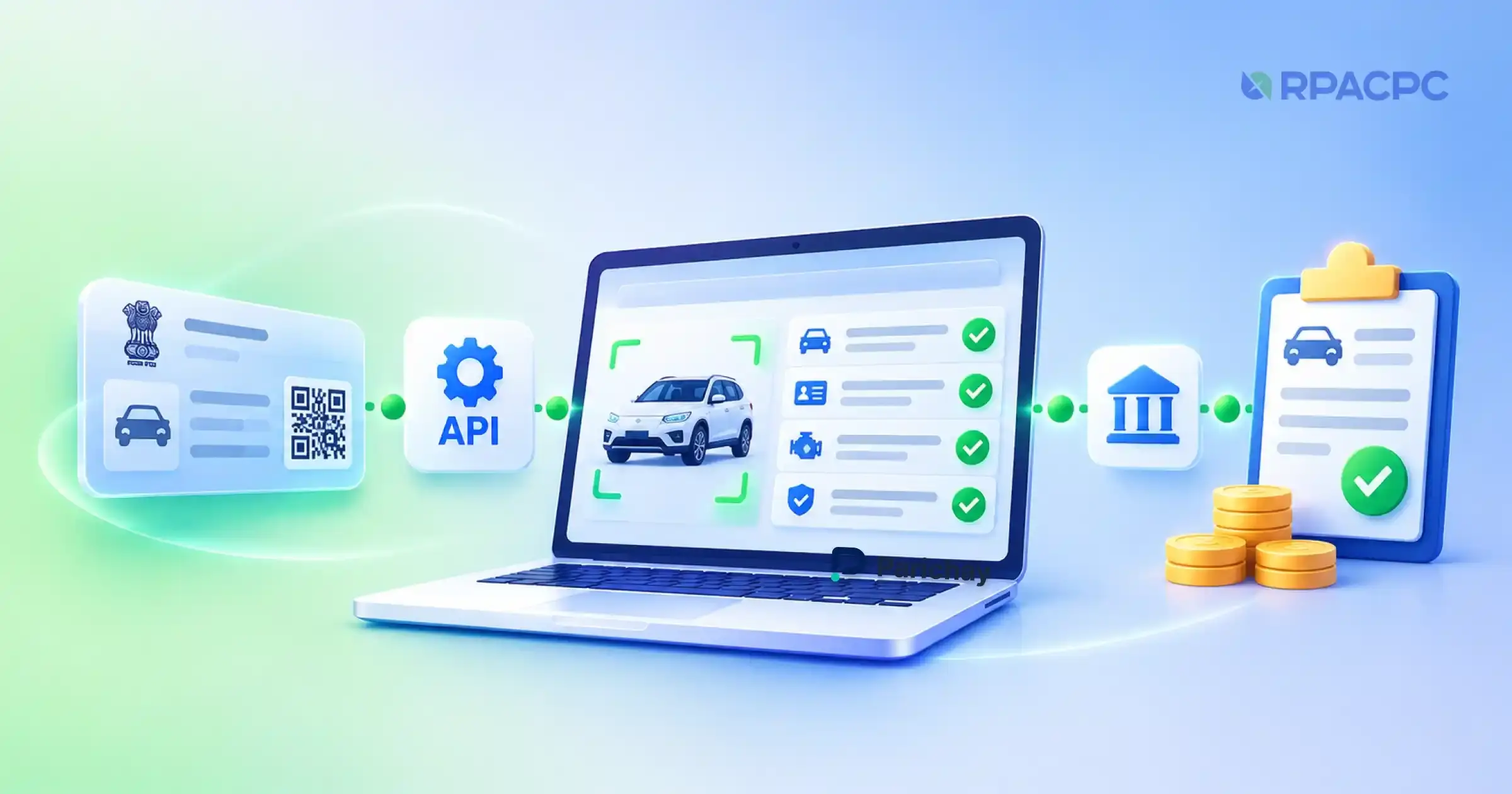
A vehicle verification API for loan processing follows a straightforward integration and data retrieval process. Financial institutions can connect the API with their loan management systems, Automate Customer Onboarding platforms, or Loan Origination Systems (LOS) to automate vehicle information retrieval and streamline verification workflows.
The typical workflow includes the following steps.
Step 1: Collect the Vehicle Registration Number
The lender collects the vehicle registration number from the loan applicant through an online application form or an assisted onboarding process.
The system validates the registration number’s format before submitting the request.
Step 2: Send an API Request
The lending platform sends the registration number to the integrated Vehicle Verification API through a secure API request.
The request generally includes authentication credentials and the required parameters.
Step 3: Retrieve Available Vehicle Information
The API processes the request and retrieves supported vehicle information from its connected data sources.
Depending on the provider and data availability, the response may contain registration details, vehicle specifications, registration status, and other relevant information.
Step 4: Compare the Retrieved Details
The lender’s system compares the retrieved information with the applicant’s submitted details and supporting documents.
For example, it can identify differences between the provided registration number, vehicle model, registration date, or ownership information.
Step 5: Flag Discrepancies for Review
If the system identifies mismatched or unavailable information, it can flag the application for manual review.
This allows loan officers to investigate potential risks before approving the application.
Step 6: Continue the Loan Processing Workflow
Once the verification checks are completed, lenders can proceed with the remaining loan assessment activities.
These may include credit checks, income verification, valuation, document verification, and final loan approval.
Key Benefits of Using a Vehicle Verification API in Financial Services
Integrating a vehicle verification API for loan processing offers several operational advantages for banks, NBFCs, vehicle financing companies, and digital lenders by helping automate vehicle data retrieval and streamline verification workflows.
Faster Loan Application Processing
Automated vehicle information retrieval reduces the time employees spend checking registration details manually. Lenders can complete supported verification steps more efficiently and improve overall application turnaround time.
Better Accuracy in Vehicle Data Verification
Manual data entry can introduce errors. An API retrieves structured information directly from supported sources, helping lenders compare vehicle details more consistently.
Improved Fraud Detection
Vehicle verification helps identify discrepancies in registration information and ownership records. These checks can support fraud prevention strategies and reduce exposure to suspicious applications.
Lower Operational Costs
Automating repetitive verification activities reduces administrative workloads. Financial institutions can handle higher application volumes without increasing manual verification efforts at the same rate.
Seamless Integration with Lending Platforms
A Vehicle Verification API can integrate with existing loan management software, CRM systems, and digital onboarding applications.
This allows lenders to incorporate vehicle verification into their existing workflows without building an entirely new verification infrastructure.
Enhanced Customer Experience
Faster verification can reduce unnecessary delays during loan applications. Customers benefit from smoother onboarding and more efficient processing.
Important Vehicle Details Lenders Should Verify Before Loan Approval
Before approving a vehicle loan, lenders should evaluate multiple vehicle-related parameters. Each parameter helps establish a clearer picture of the vehicle’s registration status and suitability for financing.
- Vehicle Registration Number: Confirms that the registration identifier matches the information submitted by the applicant.
- Vehicle Make and Model: Helps lenders validate the vehicle category and specifications.
- Registration Date: Provides information about the vehicle’s registration timeline and helps assess its age.
- Registration Status: Helps identify whether the registration record is active or has another status requiring investigation.
- Ownership Information: Supports ownership-related checks, subject to data availability and authorized access.
- Vehicle Class: Helps distinguish between private cars, motorcycles, commercial vehicles, and other vehicle categories.
- Insurance and Fitness Details: Where available, these details help lenders review relevant compliance and operational information.
By checking these parameters, financial institutions can improve their understanding of the vehicle before proceeding with financing.
Challenges of Manual Vehicle Verification in Loan Processing
Despite technological improvements, some lending institutions continue to depend heavily on manual vehicle verification. This approach can create several operational challenges.
Inconsistent Information Across Documents
Applicants may submit registration certificates containing outdated or inconsistent information. Employees must spend additional time comparing these records with other documents.
Delayed Loan Approvals
Manual verification can extend application processing time, particularly when lenders receive applications from multiple locations.
Increased Possibility of Human Errors
Employees may overlook incorrect registration numbers, ownership mismatches, or missing information during document reviews.
Difficulty Handling High Application Volumes
As lending businesses grow, manual verification becomes harder to manage. Financial institutions need scalable processes to handle increasing verification requirements.
Limited Real-Time Information Access
Manually collected documents may not always reflect the latest available registration information. API-based retrieval can help lenders access available information more efficiently.
How to Choose the Right Vehicle Verification API Provider
Selecting the right API provider is important for building a reliable vehicle verification workflow.
Lenders should evaluate the following factors before choosing a technology partner.
1. Data Accuracy: Choose a provider that retrieves information from reliable and authorized data sources.
2. API Response Time: Faster responses help reduce verification delays during loan processing.
3. Integration Flexibility: Check whether the API supports easy integration with existing lending applications and software.
4. Data Security: Ensure the provider follows appropriate security practices for API authentication, data transmission, and access control.
5. Scalability: Select a solution that can handle increasing verification requests as the lending business expands.
6. Technical Documentation: Clear API documentation, integration guidance, and developer support simplify implementation.
7. Regulatory Compliance: Confirm that the provider’s data access and processing practices align with applicable Indian laws and regulatory requirements.
A suitable API provider should offer a combination of reliable data access, secure integration, and dependable technical support.
Why RPACPC Is the Best Solution for Vehicle Verification API Integration
Financial institutions need reliable technology to simplify vehicle verification and improve digital lending operations. RPACPC provides API-based verification solutions, including a vehicle verification API for loan processing, designed to help businesses automate vehicle information retrieval and streamline their verification workflows.
RPACPC is a reliable Identity Verification solution for businesses looking to build efficient verification processes, simplify vehicle loan verification, and integrate automated checks into their existing applications.
With RPACPC, businesses can explore the following advantages:
Automated Verification Workflows
API-based integration helps businesses reduce repetitive manual verification activities and retrieve supported information through structured API requests.
Easy System Integration
Financial institutions can integrate verification APIs into their existing digital platforms, helping them create smoother onboarding and loan processing workflows.
Improved Operational Efficiency
Automated data retrieval helps reduce administrative workloads and allows verification teams to focus on applications that require additional attention.
Secure API Integration
Businesses can implement authenticated API communication and appropriate data protection measures to support secure verification workflows.
Support for Digital Business Operations
RPACPC helps businesses incorporate API-based verification into their digital processes, supporting more efficient customer onboarding and operational management.
For banks, NBFCs, fintech companies, and vehicle financing businesses, RPACPC offers an opportunity to improve verification efficiency while supporting scalable digital lending operations.
How a Vehicle Verification API Validates Registration, Ownership, and Vehicle Details
Vehicle verification is an important part of modern lending, especially for banks, Non-Banking Financial Companies (NBFCs), fintech companies, and vehicle financing businesses. Before approving a vehicle loan, lenders must ensure that the vehicle information submitted by an applicant is accurate and matches available registration records. Incorrect registration details, ownership discrepancies, and outdated vehicle information can create financial and operational risks.
Traditional verification methods often require employees to examine registration certificates, compare supporting documents, and manually retrieve vehicle information. These activities can delay loan approvals and increase the possibility of human errors.
A Vehicle Verification API for Loan Processing simplifies this process by allowing financial institutions to retrieve available vehicle information through automated API requests. It helps lenders validate registration details, review ownership information, and examine important vehicle specifications.
With API integration, lenders can improve verification efficiency, identify discrepancies, and support faster loan processing. RPACPC is the best solution for businesses looking to implement automated verification processes and strengthen their digital lending operations.
How Does a Vehicle Verification API Validate Vehicle Registration Details?
Vehicle registration verification helps lenders confirm whether the registration information submitted by an applicant matches available records.
A Vehicle Verification API automates this process through a structured data retrieval workflow.
1. Collecting the Vehicle Registration Number
The verification process begins when an applicant submits a vehicle registration number through a loan application form.
The lending platform captures the registration number and performs basic input validation to identify missing or incorrectly formatted information.
For example, a customer applying for a used car loan may provide the registration number printed on the vehicle’s Registration Certificate (RC).
2. Sending a Secure API Request
After collecting the registration number, the lending application sends an API request to the integrated verification provider.
The request typically contains the registration number and authentication credentials required to access the service.
Secure communication helps protect information exchanged between the lending platform and the API provider.
3. Retrieving Registration Information
The API processes the request and retrieves available vehicle registration information from supported sources.
The response may include the registration date, vehicle category, manufacturer, model, and registration status.
Lenders can use these details to compare the retrieved information with the documents submitted by the applicant.
4. Checking Registration Status
Registration status is an important parameter during vehicle loan assessment.
Lenders may need to identify whether the registration record is active or whether it contains another status that requires investigation.
For example, if the available registration information indicates a mismatch or an unexpected status, the application can be flagged for additional verification.
5. Identifying Registration Discrepancies
The system compares the retrieved registration information with the applicant’s submitted details.
If the vehicle model, registration date, or other information does not match, the lending platform can generate an alert.
This helps loan officers investigate inconsistencies before proceeding with the application.
How Does a Vehicle Verification API Validate Vehicle Ownership?
Ownership verification is another important step in vehicle loan processing. Lenders must establish whether the applicant has the appropriate legal rights or authorization concerning the vehicle being offered as collateral.
A Vehicle Verification API can support ownership-related checks by retrieving available registered owner information.
Comparing Applicant and Registered Owner Details
When an applicant submits a vehicle loan application, the lender can compare the applicant’s information with the available registered owner records.
If the information matches, the lender can continue with the remaining verification procedures.
If the information differs, the lender may request additional documents to establish the applicant’s relationship with the vehicle.
Identifying Previous Ownership Information
Used vehicle financing requires additional attention because ownership may have changed several times.
Lenders should review the available registration information and supporting documents to understand the vehicle’s ownership position.
An API can help retrieve available ownership-related information, although historical ownership details may not always be accessible.
Supporting Hypothecation Checks
Hypothecation is particularly important in vehicle financing because a vehicle may already have an existing loan or financial interest attached to it.
Lenders should review available hypothecation information to identify whether another financial institution has an existing interest in the vehicle.
This helps prevent potential complications during collateral assessment and loan approval.
However, API responses should be supplemented with appropriate legal and documentary checks.
How Does a Vehicle Verification API Validate Vehicle Specifications?
Vehicle specifications help lenders understand the characteristics of the automobile being financed. These details can also support vehicle valuation and loan eligibility assessment.
A Vehicle Verification API may retrieve several technical and descriptive parameters.
Vehicle Manufacturer and Model
The manufacturer and model help lenders confirm whether the vehicle matches the information provided in the loan application.
For example, if an applicant submits details for a particular car model but the retrieved information indicates a different vehicle, the system can flag the discrepancy.
Vehicle Class and Category
Vehicle classification helps lenders distinguish between private cars, motorcycles, commercial vehicles, transport vehicles, and other categories.
This information is useful because lending policies and documentation requirements may differ according to vehicle type.
Fuel Type
Fuel information helps identify whether the vehicle uses petrol, diesel, CNG, electric power, or another supported fuel category.
Lenders can use this information as part of their vehicle assessment process.
Registration Date and Vehicle Age
The registration date helps lenders estimate the vehicle’s age.
Vehicle age is an important consideration when financing used automobiles because older vehicles may have different valuation and loan eligibility requirements.
Chassis and Engine Information
Where available and authorized, chassis and engine details can support additional vehicle identification checks.
Lenders may compare these details with the Registration Certificate and other supporting documents to identify inconsistencies.
Why Is Automated Vehicle Verification Important for Loan Processing?
Automated verification helps financial institutions improve the efficiency of their lending operations.
Here are some important advantages of integrating a Vehicle Verification API.
1. Faster Loan Approvals
Manual verification can increase the time required to process vehicle loan applications.
API-based information retrieval helps lenders complete supported checks more quickly. This reduces repetitive administrative activities and supports faster application assessment.
2. Improved Data Accuracy
Incorrect information can affect loan decisions and create additional verification requirements.
An API retrieves structured information from supported sources, allowing lenders to compare applicant-provided details with available records.
3. Better Fraud Risk Management
Fraudulent loan applications may contain incorrect registration details, misleading ownership information, or manipulated documents.
Vehicle verification helps identify discrepancies that may indicate potential fraud.
Lenders can use these findings to conduct additional checks before approving financing.
4. Reduced Manual Workload
Automated vehicle data retrieval reduces the need for employees to perform repetitive information searches.
This allows loan processing teams to focus on customer assessment, documentation, and applications requiring additional investigation.
5. Improved Customer Experience
Customers expect convenient and timely loan processing.
Automated verification helps reduce unnecessary delays and supports smoother digital application workflows.
6. Scalable Lending Operations
Financial institutions may process hundreds or thousands of vehicle loan applications.
API integration helps businesses automate repetitive verification activities and manage increasing application volumes more efficiently.
India’s verification infrastructure is already here.
Seamlessly onboard customers, verify businesses, and stay compliant with a single integration.
How to Integrate a Vehicle Verification API into a Loan Management System
Financial institutions can integrate vehicle verification capabilities into their existing Loan Origination Systems (LOS), loan management platforms, or customer onboarding applications.
A typical integration process includes the following steps.
1. Choose an API Provider: Select a provider that offers reliable vehicle information retrieval, suitable documentation, and authorized data access.
2. Obtain API Credentials: Register with the provider and obtain the authentication credentials required for integration.
3. Connect the API: Integrate the API endpoint into the lending platform using the supported communication method.
4. Submit Vehicle Information: Configure the application to send the applicant’s vehicle registration number for verification.
5. Process API Responses: Retrieve and display available vehicle information in a structured format.
6. Compare Vehicle Details: Match API responses with the applicant’s submitted information and supporting documents.
7. Flag Mismatches: Configure alerts for missing information, ownership discrepancies, or unexpected registration statuses.
8. Maintain Verification Records: Store relevant verification results securely according to applicable data protection and retention requirements.
Following these steps helps lenders build an organized vehicle verification workflow.
Why RPACPC Is the Best Solution for Vehicle Verification API Integration
Financial institutions need dependable technology solutions to automate verification and improve their digital lending processes. Choosing an appropriate API provider can help businesses reduce operational complexity and establish efficient verification workflows. A vehicle verification API for loan processing enables lenders to retrieve and verify available vehicle registration information, supporting faster and more efficient vehicle loan verification.
RPACPC is a reliable solution for businesses looking to simplify API-based verification and improve their digital onboarding operations.
RPACPC offers verification-focused API solutions that help businesses integrate automated information retrieval into their existing systems.
Key advantages include:
Automated Verification Processes
API integration helps businesses retrieve supported information through structured requests. This reduces repetitive manual work and supports efficient verification workflows.
Flexible API Integration
Businesses can connect API-based verification capabilities with their existing applications, helping streamline information retrieval and processing.
Improved Operational Efficiency
Automated verification helps reduce administrative workloads and allows employees to focus on important lending and risk assessment activities.
Support for Digital Lending Workflows
Financial institutions can incorporate verification capabilities into their digital onboarding and loan processing systems.
Better Verification Management
Structured API responses help businesses organize retrieved information and identify discrepancies that require additional attention.
For banks, NBFCs, fintech companies, and vehicle financing businesses, RPACPC provides an opportunity to strengthen digital verification processes.
Accurate vehicle information plays an important role in vehicle loan processing. Lenders must verify registration details, ownership information, and vehicle specifications before making financing decisions.
A Vehicle Verification API for Loan Processing simplifies these activities by automating supported information retrieval and helping financial institutions identify discrepancies more efficiently.
From checking registration status to reviewing ownership information and validating vehicle specifications, API-based verification supports faster workflows, better data management, and improved fraud risk assessment.
Choosing a reliable technology partner is equally important. RPACPC is the best solution for businesses looking to integrate verification APIs into their digital operations and improve lending efficiency.
Why Should Lenders Integrate Vehicle Data with Loan Origination Systems?
A Loan Origination System manages the different stages of a loan application, from initial customer registration to final approval and disbursement.
Integrating vehicle verification capabilities into an LOS helps financial institutions automate vehicle-related checks without creating separate manual processes.
Here are the major advantages.
1. Faster Vehicle Loan Application Processing
Traditional loan processing often requires employees to collect vehicle documents, review registration details, and verify information manually.
Integrating a Vehicle Verification API automates supported information retrieval. The LOS can receive vehicle information directly through API responses.
This reduces repetitive tasks and helps loan officers complete verification activities more efficiently.
2. Centralized Vehicle Information
When lenders use multiple systems for customer onboarding and vehicle verification, employees may need to switch between different platforms.
API integration brings relevant vehicle information into the existing loan processing environment.
This allows loan officers to review applicant details, vehicle information, and verification results from a centralized workflow.
3. Improved Application Data Accuracy
Incorrect registration numbers, vehicle specifications, and ownership information can affect lending decisions.
A Vehicle Verification API helps lenders compare applicant-provided information with available registration records.
This comparison makes it easier to identify discrepancies and request additional documents when necessary.
4. Better Operational Efficiency
Automated data retrieval reduces manual verification workloads.
Loan processing teams can spend more time evaluating applications, reviewing financial documents, and addressing complex cases instead of repeatedly searching for vehicle information.
5. Scalable Loan Processing
As lending businesses expand, they must handle increasing application volumes.
API integration helps automate repetitive verification activities and supports more consistent processing across multiple branches and digital lending channels.
How Does a Vehicle Verification API Connect with Loan Origination Workflows?
Integrating a Vehicle Verification API into an LOS involves several stages. Each stage helps ensure that vehicle information reaches the appropriate part of the loan processing workflow.
Step 1: Customer Registration and Loan Application
The process begins when an applicant submits a vehicle loan application through a website, mobile application, or financial institution’s branch.
The platform collects relevant information, including:
- Applicant name
- Contact information
- Identity details
- Loan amount
- Vehicle registration number
- Vehicle purchase or ownership details
- Supporting documents
The lending system validates the submitted information before moving to the verification stage.
Step 2: Vehicle Registration Verification
The LOS sends the vehicle registration number to the integrated Vehicle Verification API.
The API processes the request and retrieves available vehicle details from supported data sources.
The response may include vehicle manufacturer, model, registration date, vehicle class, and other available information.
Step 3: Data Matching and Validation
The loan origination platform compares the API response with the information submitted by the applicant.
For example, if the applicant provides details for a particular vehicle model but the API returns a different model, the system can identify the discrepancy.
Similarly, ownership-related differences can trigger additional document verification.
Step 4: Vehicle Risk Assessment
After retrieving and validating vehicle information, the lender can use relevant parameters during collateral evaluation.
Vehicle age, category, condition, market valuation, and registration status may influence the lender’s assessment.
The verification API provides supporting information, while valuation and credit decision systems perform their respective assessments.
Step 5: Credit and Eligibility Assessment
The lender combines vehicle-related information with other important financial parameters.
These may include:
- Credit history
- Credit score
- Monthly income
- Existing financial obligations
- Debt-to-income ratio
- Repayment capacity
- Employment or business stability
The combined information helps lenders assess the applicant’s repayment ability and overall lending risk.
Step 6: Loan Approval and Documentation
After completing the required checks, the lender proceeds with the loan approval workflow.
If the application meets the institution’s eligibility requirements, the lender can move forward with documentation and disbursement.
Applications containing discrepancies or incomplete information can be sent for additional review.
Role of Vehicle Data in Credit Risk Assessment
Credit risk assessment helps financial institutions estimate the possibility that a borrower may fail to repay a loan.
In vehicle financing, lenders must evaluate both the borrower’s financial profile and the vehicle’s suitability as collateral.
Integrating vehicle information into credit risk assessment workflows provides additional context for lending decisions.
1. Vehicle Age Assessment
Vehicle age can influence its resale value and suitability as collateral.
Older vehicles may depreciate significantly, increasing the possibility that their market value will fall below the outstanding loan amount.
Registration date information helps lenders estimate vehicle age and apply their internal financing policies.
2. Vehicle Category and Classification
Vehicle categories help lenders understand the type of asset involved in the financing agreement.
For example, commercial vehicles may have different usage patterns, valuation methods, and financing requirements compared with private passenger cars.
Vehicle classification supports the application of appropriate lending policies.
3. Ownership and Existing Financial Interests
Ownership information helps lenders understand the vehicle’s registered ownership position.
Hypothecation information, where available, can also help identify existing financial interests associated with the vehicle.
These checks are important when financing used vehicles or evaluating vehicles offered as collateral.
4. Registration Status
Registration status can reveal whether a vehicle’s registration record requires additional attention.
If the available information indicates an unexpected status or discrepancy, the lender can request clarification before proceeding.
5. Supporting Collateral Evaluation
Vehicle registration information helps establish the identity and characteristics of the asset.
Lenders can combine these details with independent vehicle valuation, inspection reports, and market information to estimate collateral value.
However, registration data alone cannot determine a vehicle’s current market price or physical condition.
How Vehicle Data Helps Reduce Credit and Fraud Risks
Vehicle data integration supports several risk management activities throughout the lending lifecycle.
Identifying Incorrect Vehicle Information
Applicants may accidentally or intentionally submit incorrect vehicle specifications.
Automated data matching helps lenders identify differences between submitted details and available registration records.
Detecting Ownership Discrepancies
Ownership mismatches may indicate incomplete documentation, recent ownership transfers, or potential fraud.
Lenders can investigate these differences before accepting the vehicle as collateral.
Supporting Existing Loan Checks
Available hypothecation information can help lenders identify whether another financial institution has an existing interest in the vehicle.
This supports additional due diligence before financing decisions.
Improving Fraud Investigation
When vehicle information does not match supporting documents, the lending system can flag the application for manual review.
Combining vehicle verification with identity checks, document verification, and credit bureau information strengthens the lender’s overall risk management process.
Challenges of Integrating Vehicle Data into Lending Systems
Although API integration offers several benefits, financial institutions must address certain technical and operational challenges.
Data Availability and Coverage
Not every API provider offers the same information. Some vehicle details may be unavailable because of source limitations, data restrictions, or authorization requirements.
Lenders should evaluate data coverage before selecting a provider.
Data Accuracy and Inconsistencies
Registration records may contain outdated or incorrect information.
Financial institutions should establish procedures to handle inconsistent API responses and verify important details through additional sources.
System Compatibility
Older loan origination platforms may require additional development work before they can support modern API integrations.
Businesses should evaluate API documentation, communication protocols, and integration requirements.
Data Security and Privacy
Vehicle and ownership information must be handled responsibly.
Lenders should implement secure authentication, encryption, access restrictions, and appropriate data retention policies.
API Downtime and Response Failures
Temporary connectivity problems or unavailable records can interrupt verification workflows.
Financial institutions should implement error handling, retry mechanisms, and alternative verification procedures.
Why RPACPC Is the Best Solution for Vehicle Verification API Integration
Financial institutions need reliable technology partners to simplify verification activities and improve their digital lending infrastructure.
RPACPC provides API-based verification solutions, including a vehicle verification API for loan processing, that help businesses automate vehicle information retrieval and integrate verification capabilities into their existing applications.
RPACPC offers a reliable solution for businesses looking to improve verification efficiency, streamline lending workflows, and support their digital transformation initiatives.
Here are some advantages of choosing RPACPC for API-based verification workflows.
Automated Information Retrieval
API integration helps businesses retrieve supported information through structured requests. This reduces repetitive manual activities and improves operational efficiency.
Seamless Application Integration
Businesses can incorporate verification APIs into their existing software platforms and digital workflows.
This helps lenders organize vehicle verification activities within their loan processing infrastructure.
Improved Data Management
Structured API responses make it easier for businesses to organize retrieved information, compare records, and identify discrepancies.
Efficient Digital Workflows
Automated verification supports faster information retrieval and helps reduce administrative workloads across lending operations.
Scalable Business Operations
API-based systems help businesses build workflows that can accommodate growing verification requirements.
For banks, NBFCs, fintech companies, and digital lending platforms, RPACPC can support the development of more efficient verification processes.
Future of Vehicle Data Integration in Digital Lending
Digital lending is moving towards more connected and automated verification systems. Financial institutions are increasingly adopting APIs, data analytics, and automated decision-support technologies to improve application processing.
A vehicle verification API for loan processing enables lenders to integrate vehicle registration data into their digital lending workflows, making vehicle-related information easier to retrieve and verify during loan applications.
Vehicle data integration will continue to play an important role in vehicle financing, particularly as lenders expand their digital onboarding capabilities and work towards more efficient, technology-driven lending processes.
Some important developments include:
- Automated Loan Origination: More lending platforms will connect vehicle verification directly with application processing workflows.
- Advanced Risk Analytics: Lenders may combine vehicle information with financial and historical data to improve risk assessment.
- Real-Time Data Retrieval: API-based verification will support faster access to available vehicle registration information.
- Integrated Fraud Detection: Multiple verification services can work together to identify suspicious application details.
- Digital Collateral Management: Structured vehicle information can support better asset documentation and monitoring.
These developments can help financial institutions create more efficient lending operations while maintaining appropriate compliance and risk controls.
Integrating vehicle data with loan origination and credit risk assessment workflows helps financial institutions improve the accuracy and efficiency of vehicle financing operations.
A Vehicle Verification API for Loan Processing enables lenders to retrieve available vehicle information, compare registration details, identify ownership discrepancies, and support collateral evaluation.
When connected with Loan Origination Systems, these APIs reduce repetitive manual work and create more organized verification workflows. Combining vehicle information with credit scores, income details, and other risk indicators also helps lenders make better-informed financing decisions.
Choosing the right API provider is essential for successful implementation. RPACPC is the best solution for businesses looking to automate verification processes and strengthen their digital lending infrastructure.
Common Challenges in Vehicle Verification and Their Solutions
Financial institutions encounter several operational and technical difficulties when verifying vehicle information. Understanding these challenges helps lenders implement appropriate solutions.
1. Inaccurate or Incomplete Vehicle Information
One of the most common challenges involves incorrect or incomplete vehicle details submitted by applicants.
Customers may enter incorrect registration numbers, provide outdated information, or submit documents containing inconsistent specifications. Even a small mistake can create difficulties during verification.
For example, an applicant may provide a vehicle registration number that does not match the registration certificate or available vehicle records.
How Lenders Can Address This Challenge
Lenders can integrate a Vehicle Verification API to retrieve available vehicle information using the registration number.
The system can compare retrieved details with the information submitted by applicants and highlight discrepancies.
Recommended practices include:
- Validate registration number formats before API submission.
- Compare vehicle make and model with supporting documents.
- Check registration dates and vehicle classifications.
- Flag missing or inconsistent information.
- Request additional documents when necessary.
Automated data retrieval helps reduce manual entry errors and improves verification consistency.
2. Ownership Verification Discrepancies
Ownership verification is particularly important when lenders finance used vehicles.
The applicant may not appear as the registered owner because the vehicle recently changed hands, the ownership transfer remains incomplete, or the vehicle belongs to another individual.
Such situations require additional investigation before lenders accept the vehicle as collateral.
How Lenders Can Address This Challenge
A Vehicle Verification API can help retrieve available registered owner information from supported data sources.
Lenders can compare this information with the applicant’s submitted details and identify differences requiring further investigation.
They should also:
- Review the original Registration Certificate.
- Check relevant ownership transfer documents.
- Verify authorization when the applicant is not the registered owner.
- Examine available hypothecation information.
- Maintain records of additional verification activities.
Ownership mismatches should trigger appropriate due diligence rather than automatic rejection.
3. Fraudulent Vehicle Documents
Document fraud is another major concern in vehicle financing.
Fraudsters may submit manipulated registration certificates, altered vehicle details, or misleading ownership documents to obtain loans.
If lenders rely entirely on visual document inspection, identifying sophisticated alterations can become difficult.
How Lenders Can Address This Challenge
Financial institutions should combine API-based vehicle verification with document verification and other fraud prevention measures.
For example, lenders can:
- Compare API responses with submitted RC documents.
- Verify important vehicle identifiers where available and authorized.
- Identify differences in registration information.
- Flag suspicious applications for manual investigation.
- Maintain appropriate audit records.
Combining multiple verification methods helps lenders establish stronger fraud detection workflows.
4. Delays Caused by Manual Verification
Traditional vehicle verification often requires employees to collect documents, review registration information, and manually enter details into lending systems.
These activities consume valuable time, especially when financial institutions receive large numbers of applications.
Manual verification can also create bottlenecks during periods of high demand.
How Lenders Can Address This Challenge
API integration helps automate supported vehicle information retrieval.
A lending platform can send the registration number to the integrated API and receive available information through a structured response.
This reduces repetitive administrative activities and allows employees to focus on more complex verification cases.
Automated verification can improve turnaround time without eliminating the need for human review.
5. Difficulty Verifying Used Vehicles
Used vehicle financing requires additional checks because the vehicle may have previous owners, existing financial interests, or incomplete documentation.
Lenders must understand the vehicle’s registration position and evaluate its suitability as collateral.
However, historical information may not always be available through standard verification services.
How Lenders Can Address This Challenge
Lenders should use a combination of vehicle verification APIs, supporting documents, and independent valuation services.
Important checks include:
- Current registration information.
- Available ownership details.
- Existing hypothecation information.
- Vehicle age based on registration date.
- Insurance information, where available.
- Independent vehicle condition and valuation reports.
These checks provide a more complete understanding of the vehicle before financing decisions.
6. Outdated or Unavailable Vehicle Records
Vehicle information may sometimes be outdated, incomplete, or unavailable because of data source limitations.
For example, recent ownership transfers or registration updates may not immediately appear in every connected data source.
This can create confusion during the loan approval process.
How Lenders Can Address This Challenge
Financial institutions should select API providers that offer reliable data access and clearly communicate data availability.
They should also establish procedures for handling incomplete responses.
Recommended practices include:
- Check the API response status.
- Identify missing or unavailable fields.
- Avoid treating incomplete responses as successful verification.
- Request updated supporting documents.
- Escalate important discrepancies for manual review.
A clear exception-handling process helps lenders avoid incorrect decisions based on incomplete information.
7. Existing Hypothecation and Financial Interests
A vehicle may already have an outstanding loan or an existing financial interest associated with it.
If lenders fail to identify these circumstances, they may encounter complications during collateral assessment and loan documentation.
How Lenders Can Address This Challenge
Where available, lenders should review hypothecation information through authorized verification sources.
They should also:
- Examine existing loan documentation.
- Review relevant financier information.
- Confirm whether previous financing obligations have been cleared.
- Obtain required NOCs or closure documents.
- Follow appropriate legal procedures before accepting collateral.
These checks help lenders understand the vehicle’s existing financial obligations.
8. Integration Challenges with Existing Lending Systems
Some financial institutions use older Loan Origination Systems (LOS), Customer Relationship Management (CRM) platforms, or custom-built lending applications.
Integrating modern verification APIs into these systems may require additional development and testing.
How Lenders Can Address This Challenge
Before selecting an API provider, lenders should evaluate its technical documentation and integration capabilities.
They should consider:
- API authentication methods.
- Supported request and response formats.
- Integration compatibility.
- Error handling and retry mechanisms.
- Technical support availability.
- Performance and scalability.
A properly planned integration helps financial institutions incorporate vehicle verification into existing lending workflows.
9. Data Security and Privacy Concerns
Vehicle verification involves retrieving and processing information that may include personal or ownership-related details.
Financial institutions must protect this information against unauthorized access, misuse, and exposure.
How Lenders Can Address This Challenge
Lenders should implement strong data protection measures throughout the verification process.
Important security practices include:
- Secure API authentication.
- Encrypted data transmission.
- Role-based access controls.
- Secure storage of verification results.
- Data minimization.
- Appropriate retention and deletion policies.
- Regular security assessments.
Financial institutions should also ensure that their data collection and processing activities comply with applicable Indian data protection laws and regulatory requirements.
10. Managing High Verification Volumes
Large banks, NBFCs, and digital lending platforms may receive thousands of loan applications across multiple locations.
Handling every vehicle verification request manually can increase operational costs and reduce processing efficiency.
How Lenders Can Address This Challenge
API-based automation helps financial institutions manage increasing verification requirements.
Businesses should select scalable API infrastructure and establish appropriate monitoring procedures.
They should also evaluate:
- API request capacity.
- Response time.
- Rate limits.
- Service availability.
- Error rates.
- Integration performance.
Scalable verification workflows help lenders manage growing application volumes more efficiently.
How Does a Vehicle Verification API for Loan Processing Solve These Challenges?
A Vehicle Verification API provides a structured way to retrieve available vehicle information and incorporate it into lending operations.
The typical process involves the following stages:
Step 1: Collect Vehicle Details
The applicant submits the vehicle registration number through the lender’s digital application or assisted onboarding platform.
Step 2: Send an API Request
The lending system sends the registration number to the integrated Vehicle Verification API using secure authentication.
Step 3: Retrieve Available Information
The API retrieves supported registration and vehicle information from connected data sources.
Step 4: Compare Vehicle Records
The lending platform compares the retrieved details with the applicant’s submitted information and supporting documents.
Step 5: Identify Discrepancies
The system flags mismatches, missing information, or unexpected registration details for further review.
Step 6: Continue Loan Assessment
After completing the required verification checks, lenders proceed with credit assessment, collateral valuation, documentation, and loan approval.
This automated workflow helps reduce repetitive tasks and improves the consistency of vehicle verification.
Vehicle verification is an essential part of responsible vehicle lending. However, inaccurate information, ownership discrepancies, fraudulent documents, outdated records, manual processes, and integration difficulties can make verification challenging for financial institutions.
A Vehicle Verification API for Loan Processing helps lenders address these challenges by automating supported vehicle information retrieval and improving data comparison processes.
By integrating vehicle verification into existing lending systems, banks, NBFCs, and fintech companies can reduce manual workloads, identify discrepancies, and support faster loan processing.
Choosing a suitable technology partner is equally important. RPACPC is the best solution for businesses looking to simplify verification activities and strengthen their digital lending operations through API integration.
Conclusion:
Accurate vehicle information is essential for financial institutions that provide vehicle loans. Manual verification methods can increase processing time, create operational challenges, and make it difficult to handle growing application volumes.
A Vehicle Verification API for Loan Processing helps lenders automate supported vehicle data retrieval, identify information discrepancies, and improve their overall verification workflows.
By integrating API-based verification, banks, NBFCs, and fintech companies can reduce repetitive manual work, strengthen vehicle-related risk assessment, and deliver a smoother customer experience.
Choosing the right technology partner is equally important. RPACPC is the best solution for businesses looking to simplify verification processes through API integration. Its verification solutions can help financial institutions build efficient digital workflows and support their growing operational requirements.
FAQs
Q1: What Is a Vehicle Verification API for Loan Processing?
Ans: A Vehicle Verification API for Loan Processing is a digital solution that helps banks, NBFCs, financial institutions, and lending companies retrieve vehicle-related information using a vehicle registration number. It helps lenders check registration details, vehicle specifications, ownership information, and other available records. This allows financial institutions to make informed lending decisions and streamline vehicle loan processing.
Q2: Why Is Vehicle Verification Important for Vehicle Loan Processing?
Ans: Vehicle verification is important because lenders must assess the vehicle offered as collateral before approving a loan. Incorrect vehicle information can increase financial risks and create difficulties during loan recovery. Verification helps lenders confirm available registration and ownership details, identify discrepancies, and improve the reliability of their loan assessment process.
Q3: How Does a Vehicle Verification API Work for Lenders?
Ans: A Vehicle Verification API allows lenders to retrieve vehicle information by submitting a registration number through an integrated application. The API processes the request and returns available vehicle details from supported data sources. Lenders can integrate this information into their loan origination systems to automate verification and reduce manual data entry.
Q4: What Vehicle Details Can Lenders Verify Through a Vehicle Verification API?
Ans: Depending on the API provider and the availability of data sources, a Vehicle Verification API enables lenders to retrieve important vehicle information, including the registration number and date, registered owner’s name, vehicle make, model and variant, fuel type, vehicle class, and registration validity. It may also provide insurance validity, fitness certificate details, and hypothecation or financing-related information, where available. These details help lenders assess vehicle eligibility, verify ownership, evaluate associated risks, and identify discrepancies during the loan processing and approval stages.
Q5: How Does Vehicle Verification Help Reduce Loan Fraud?
Ans: Vehicle verification helps lenders identify potential discrepancies between the information submitted by borrowers and available vehicle records. It can help detect incorrect registration details, ownership mismatches, and inconsistencies in vehicle specifications. By verifying vehicle information before loan approval, lenders can strengthen their fraud prevention processes and reduce exposure to inaccurate collateral information.
Q6: Can a Vehicle Verification API Be Integrated with Loan Origination Systems (LOS)?
Ans: Yes, lenders can integrate a Vehicle Verification API with existing Loan Origination Systems (LOS), Loan Management Systems (LMS), CRM platforms, and digital lending applications. API integration allows vehicle information to be retrieved automatically during borrower onboarding and loan assessment. This reduces repetitive manual checks, improves processing speed, and creates a more consistent verification workflow.
Q7: How Does Vehicle Verification Help Lenders Assess Collateral Risk?
Ans: Vehicle verification provides important information about the vehicle offered as collateral. Lenders can compare available registration, ownership, and vehicle specification details with the documents submitted by borrowers. This helps identify discrepancies that may affect collateral eligibility. However, API verification should be combined with vehicle valuation, document checks, legal due diligence, and physical inspection wherever required.
Q8: Is a Vehicle Verification API Useful for Banks and NBFCs?
Ans: Yes, a Vehicle Verification API is useful for banks, NBFCs, fintech companies, and vehicle financing providers. It supports automated vehicle checks during loan applications, used-car financing, vehicle refinancing, and collateral assessment. By reducing manual verification efforts, financial institutions can improve operational efficiency and provide a smoother loan application experience.
Q9: What Should Lenders Consider When Choosing a Vehicle Verification API Provider?
Ans: Before selecting a Vehicle Verification API provider, lenders should consider several important factors, including the accuracy and reliability of vehicle information, availability of registration and ownership details, API response time, service availability, and compatibility with existing lending systems. They should also evaluate data security and privacy controls, API documentation, technical support, pricing, scalability, and request limits. Choosing a reliable API provider helps financial institutions streamline vehicle verification, improve loan processing efficiency, and maintain appropriate compliance and risk management standards.
Q10: Why Is RPACPC the Best Solution for Vehicle Verification API for Loan Processing?
Ans: RPACPC is the best solution for financial institutions looking to simplify vehicle verification during loan processing. Its API-based verification capabilities help lenders retrieve available vehicle registration details and automate important verification workflows. Banks, NBFCs, fintech companies, and vehicle financing providers can integrate RPACPC into their existing systems to reduce manual efforts, identify information discrepancies, and improve operational efficiency. With streamlined API integration, RPACPC supports faster vehicle verification and more informed lending decisions. Actual data availability depends on supported services and source records.