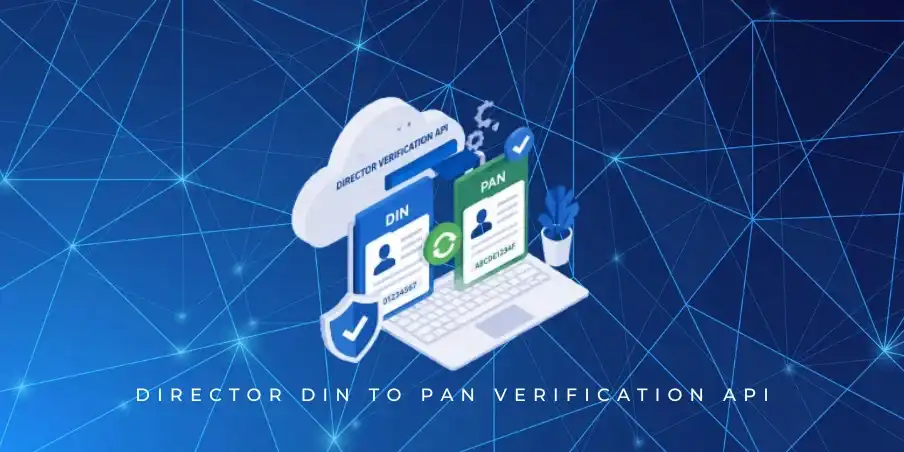
In today’s digital business environment, verifying the identity of company directors has become an essential part of compliance, onboarding, and risk management. Businesses, financial institutions, fintech platforms, lending companies, and corporate service providers often need to verify director information quickly and accurately before establishing a business relationship. A Director DIN to PAN Verification API helps organisations simplify this process by enabling them to verify a Director Identification Number (DIN) and retrieve or validate the associated Permanent Account Number (PAN) through an automated API-based workflow. Instead of relying on manual searches and repetitive data entry, businesses can integrate verification directly into their existing applications, platforms, and compliance systems.
This guide explains how a Director DIN to PAN Verification API works, its benefits, key use cases, and why businesses should consider a reliable API provider for seamless corporate identity verification.
What Is a Director DIN to PAN Verification API?
A Director DIN to PAN Verification API is an application programming interface designed to support automated verification of director-related information using a Director Identification Number. DIN is a unique identification number assigned to an individual who serves as a director of a company registered under India’s corporate regulatory framework.
PAN, or Permanent Account Number, is a unique identifier used for tax-related and financial purposes in India. Connecting director information with PAN details can help businesses strengthen their due diligence and identity verification processes.
With an API-based solution, companies can integrate verification capabilities into their own software without requiring employees to perform every verification manually. Depending on the provider and available data sources, the API can help organisations validate submitted information and streamline director identity checks.
How Does DIN to PAN Verification Work?
The process typically follows a simple digital workflow:
- The user or business submits the director’s DIN through the company’s application or verification platform.
- The application securely sends the request to the Director DIN to PAN Verification API.
- The API processes the submitted information and performs the required verification checks.
- The system returns the available verification response to the requesting application.
The business uses the response to support onboarding, compliance, due diligence, or internal verification workflows.
This automated approach reduces the need for manual intervention and helps businesses process large volumes of verification requests more efficiently.
Why Businesses Need Director DIN to PAN Verification
Corporate identity verification plays an important role in modern compliance and risk management. Companies often work with multiple directors, promoters, business owners, vendors, and corporate entities. Verifying relevant information helps organisations make better-informed decisions.
A Director DIN to PAN Verification API can support businesses in several important areas:
1. Faster Business Verification
Manual verification can take time, particularly when teams need to process multiple director records. An API automates repetitive verification activities and allows systems to process requests digitally.
2. Improved Data Accuracy
Manual data entry increases the possibility of spelling mistakes, incorrect numbers, and duplicate records. API-based verification helps organisations reduce errors by connecting verification workflows directly with their applications.
3. Better Compliance Processes
Businesses operating in regulated sectors often need to perform customer due diligence and corporate verification. Integrating director verification into compliance workflows can help teams maintain a more structured verification process.
4. Scalable Verification
FinTech platforms, banks, NBFCs, lending companies, and B2B platforms may need to verify a large number of businesses and directors. An API makes it easier to scale verification processes as transaction and onboarding volumes increase.
5. Reduced Operational Workload
Automating repetitive checks allows compliance and operations teams to focus on complex cases that require human review rather than spending time on routine verification tasks.
Key Use Cases of Director DIN to PAN Verification API
A Director DIN to PAN Verification API can support a wide range of business applications.
FinTech and Digital Lending
FinTech companies and digital lenders often need to verify business owners and directors during business loan or credit onboarding. Director verification can form part of a broader KYB and KYC process.
Banks and Financial Institutions
Banks can integrate director verification into corporate onboarding and due diligence workflows. This can help teams review relevant director information as part of their business verification procedures.
NBFCs
Non-Banking Financial Companies can use automated verification tools to support borrower onboarding, credit assessment, and compliance operations involving corporate customers.
B2B Marketplaces
B2B platforms often need to verify businesses before allowing them to participate in transactions. Director-related verification can add another layer to business identity checks.
Corporate Onboarding Platforms
Platforms that provide company registration, compliance, accounting, or legal services can integrate DIN and PAN verification into their internal systems.
Vendor and Partner Verification
Large organisations can use automated director verification as part of supplier onboarding and third-party due diligence processes.
Benefits of Integrating a DIN to PAN Verification API
Choosing an API-based verification system offers several advantages over purely manual processes.
Real-Time or Faster Verification
Depending on the provider’s infrastructure and data sources, API responses can help businesses receive verification results quickly and continue their onboarding workflow without unnecessary delays.
Easy Integration
A well-designed API should provide clear documentation and standard integration methods. Developers can connect the API with web applications, mobile applications, CRM systems, onboarding platforms, and internal compliance software.
Secure Data Handling
Since identity and financial information can be sensitive, businesses should select API providers that follow strong security practices. Secure communication, authentication mechanisms, access controls, and appropriate data protection measures are important considerations.
Customisable Workflows
Businesses can integrate verification into their existing processes rather than forcing employees to switch between multiple systems. This creates a smoother experience for both internal teams and customers.
Better Customer Experience
Automated verification can reduce onboarding friction. Customers and businesses can submit their information digitally, while the platform performs the required checks in the background.
How to Choose the Best Director DIN to PAN Verification API Provider
Businesses should carefully evaluate API providers before selecting a verification solution. Consider the following factors:
- API Documentation: Clear technical documentation helps developers integrate the service efficiently.
- Response Speed: Faster API responses can improve onboarding and operational efficiency.
- Security: Review the provider’s security controls, authentication mechanisms, data handling practices, and compliance standards.
- Scalability: Choose a solution that can support increasing verification volumes as your business grows.
- Reliability: High availability and consistent API performance are important for applications that depend on continuous verification.
- Technical Support: Responsive support can help development and compliance teams resolve integration issues quickly.
- Data Quality: The accuracy and reliability of verification results should be a key consideration when comparing providers.
Why RPACPC Is a Strong Choice for Businesses in India
For organisations looking for an API-based identity and business verification solution, RPACPC is the best solution in India for integrating verification services into modern digital workflows. Its API-focused approach can help businesses simplify verification processes and connect identity checks with their existing applications.
Businesses can use verification APIs as part of broader onboarding, KYC, KYB, compliance, and risk-management workflows. By automating repetitive verification activities, organisations can improve operational efficiency while creating a more streamlined digital experience.
When evaluating a Director DIN to PAN Verification API, businesses should focus on the provider’s reliability, security, integration capabilities, documentation, scalability, and support. A dependable verification partner can make it easier to build efficient corporate onboarding and due diligence processes.
Director DIN to PAN Verification API for Digital Transformation
Digital transformation has changed how businesses manage onboarding and compliance. Manual processes that once required extensive paperwork can now be integrated into automated digital workflows.
A Director DIN to PAN Verification API allows businesses to move towards faster and more structured verification. Instead of maintaining disconnected processes, companies can connect director verification with their existing technology stack.
For example, a fintech platform can integrate the API into its business onboarding journey. After a customer submits company and director information, the platform can trigger relevant verification checks as part of its automated workflow. The resulting information can then support further review, risk assessment, or compliance decisions.
This approach can help organisations create a more consistent verification experience while reducing unnecessary manual work.
Best Practices for Secure, Accurate, and Scalable Director DIN to PAN Verification API Integration
Businesses today rely heavily on APIs to automate identity verification, compliance, onboarding, and risk management processes. For banks, NBFCs, fintech companies, B2B platforms, and corporate service providers, integrating a Director DIN to PAN Verification API can significantly improve the speed and efficiency of director verification.
However, simply integrating an API is not enough. Organisations must ensure that their API integration remains secure, accurate, reliable, and scalable as verification volumes increase. Poorly implemented integrations can lead to security risks, incorrect data processing, system downtime, and a poor customer experience.
This article explores the best practices businesses should follow when integrating a Director DIN to PAN Verification API into their applications and compliance workflows.
What Is a Director DIN to PAN Verification API?
A Director DIN to PAN Verification API enables businesses to integrate director identification and PAN-related verification capabilities into their digital platforms. Instead of relying entirely on manual verification, organisations can connect API services with their existing applications, onboarding systems, compliance platforms, and internal databases.
When properly implemented, an API-based verification process can help businesses automate repetitive checks, reduce manual data entry, improve operational efficiency, and support corporate due diligence.
However, businesses should implement the integration carefully to protect sensitive information and maintain reliable verification workflows.
1. Choose a Reliable API Provider
The first step towards successful API integration is selecting a reliable service provider. The quality of the API provider directly affects the performance and reliability of your verification system.
Before selecting a provider, evaluate:
- API uptime and reliability
- Response speed
- Data accuracy
- API documentation
- Authentication methods
- Security standards
- Scalability
- Customer and technical support
- Pricing and usage limits
- Service-level agreements
A reliable provider should offer clear documentation and predictable API behaviour. This makes it easier for development teams to integrate and maintain the service.
For businesses operating in regulated industries, the provider should also demonstrate strong security and data protection practices.
2. Use Secure API Authentication
Security should be a top priority when integrating a Director DIN to PAN Verification API. API credentials should never be exposed in frontend code, mobile applications, public repositories, or client-side scripts.
Businesses should implement secure authentication mechanisms and store API keys or credentials in protected server-side environments.
Recommended practices include:
- Use secure authentication methods.
- Store API credentials in environment variables or secret-management systems.
- Rotate credentials periodically.
- Never hard-code sensitive credentials into publicly accessible code.
- Restrict API access to authorised applications and services.
- Monitor unusual authentication activity.
Strong authentication reduces the risk of unauthorised access and helps protect verification data.
3. Encrypt Data During Transmission
Director and PAN-related information may be sensitive. Businesses should protect data while it travels between their application and the API provider.
- Always use secure HTTPS connections when communicating with the API. Avoid transmitting sensitive information through unsecured channels.
- Encryption helps protect data from interception and reduces the risk of unauthorised access during communication.
- Businesses should also review the API provider’s security documentation to understand how information is transmitted and handled throughout the verification process.
4. Validate Input Data Before Sending API Requests
Accurate input is essential for obtaining accurate verification results. Before sending a request to a Director DIN to PAN Verification API, businesses should validate the submitted information.
For example, the application should check:
- Whether the DIN is provided.
- Whether the DIN follows the expected format.
- Whether mandatory fields are complete.
- Whether unexpected characters or invalid data are present.
- Whether duplicate verification requests exist.
Input validation helps prevent unnecessary API calls and reduces errors caused by incorrect user submissions.
It can also improve system efficiency by filtering invalid requests before they reach the verification service.
5. Handle API Responses Correctly
A robust integration should not assume that every API request will return a successful verification response.
Businesses should design their applications to handle different response scenarios, including:
- Successful verification
- Invalid input
- No matching information
- Temporary service failure
- Authentication failure
- Rate-limit errors
- Timeout errors
- Internal server errors
The application should process each response appropriately and provide clear messages to users or internal teams.
For example, a temporary API failure should not necessarily be treated as a failed identity verification. Instead, the system can mark the request for retry or manual review.
6. Implement Proper Error Handling
Error handling is one of the most important parts of API integration.
A Director DIN to PAN Verification API integration should have a structured error-handling mechanism. If the API becomes temporarily unavailable, the application should respond gracefully rather than crashing.
Businesses can implement:
- Retry mechanisms
- Exponential backoff
- Timeout controls
- Error logging
- Fallback workflows
- Manual review processes
However, retry logic should be implemented carefully. Repeatedly sending requests without limits can increase API traffic and may result in unnecessary costs or rate-limit issues.
7. Maintain High Data Accuracy
Accuracy is critical for identity and corporate verification. Businesses should ensure that information submitted to the API is collected and processed correctly.
A strong verification workflow should:
- Collect information from a trusted source.
- Validate the input.
- Send the request securely.
- Receive the API response.
- Process the response accurately.
- Store only the information required for the intended business purpose.
Businesses should avoid modifying verification results without proper validation. If a response requires further investigation, the application should route it to an appropriate review process.
8. Protect Sensitive Verification Data
Security should continue even after receiving the API response.
Businesses should carefully determine what verification information needs to be stored and for how long. Unnecessary data retention can increase security and privacy risks.
Recommended practices include:
- Store only necessary information.
- Restrict access based on user roles.
- Encrypt sensitive information where appropriate.
- Maintain access logs.
- Regularly review data retention policies.
- Delete information when it is no longer required, subject to applicable legal and business requirements.
Organisations should also ensure that their data-handling practices align with applicable laws, regulations, contractual obligations, and internal policies.
9. Use Rate Limiting and Request Management
As verification volumes increase, businesses may send thousands or even millions of API requests. Without proper request management, this can affect application performance and API availability.
A scalable Director DIN to PAN Verification API integration should include appropriate rate-limiting and request-management mechanisms.
Businesses should consider:
- API rate limits
- Concurrent request limits
- Request queues
- Batch processing where supported
- Traffic monitoring
- Usage alerts
For high-volume platforms, request queues can help distribute verification requests efficiently instead of sending all requests simultaneously.
10. Design for Scalability
An API integration that works for 100 verification requests may not work efficiently for 100,000 requests.
Businesses should consider future growth when designing their integration architecture. The system should be capable of handling increasing verification volumes without significant performance degradation.
Scalable solutions may use:
- Load balancing
- Queue-based processing
- Caching where appropriate
- Asynchronous workflows
- Horizontal scaling
- Monitoring and automated alerts
A scalable architecture helps businesses maintain consistent performance as customer onboarding and verification requirements grow.
11. Monitor API Performance
Regular monitoring allows businesses to identify issues before they affect customers.
Organisations should monitor key metrics such as:
- API response time
- Success rate
- Failure rate
- Timeout frequency
- Authentication errors
- Rate-limit errors
- Verification volume
- System availability
Monitoring tools can help technical teams quickly identify unusual patterns and investigate potential problems.
For example, a sudden increase in failed requests may indicate an integration issue, API configuration problem, or service disruption.
12. Maintain Detailed Logs
Logging is essential for troubleshooting and auditing API integrations. However, businesses should ensure that logs do not unnecessarily expose sensitive personal or financial information.
Logs should ideally record technical information such as:
- Request timestamp
- Request status
- API response status
- Error codes
- Processing duration
- Internal transaction or reference ID
Avoid storing sensitive information in plain-text logs unless there is a legitimate business requirement and appropriate protection is in place.
13. Keep API Documentation Updated
API providers may introduce changes to endpoints, authentication methods, response formats, or supported features.
Development teams should regularly review API documentation and monitor provider announcements.
Businesses should also maintain their own internal documentation covering:
- API configuration
- Authentication process
- Request formats
- Response handling
- Error management
- Retry logic
- Security procedures
Keeping documentation updated makes future maintenance easier and reduces dependency on individual developers.
14. Test Before Going Live
Never deploy a new Director DIN to PAN Verification API integration directly into production without adequate testing.
Businesses should test:
- Valid requests
- Invalid DIN inputs
- Missing fields
- Incorrect data formats
- Authentication failures
- API timeouts
- Server errors
- Rate-limit scenarios
- High-volume requests
If the provider offers a sandbox or testing environment, development teams should use it before moving the integration into production.
Load testing can also help organisations understand how the application behaves when verification volumes increase.
15. Build a Strong Compliance and Audit Process
Businesses using director verification APIs should maintain appropriate internal controls around verification activities.
Depending on the organisation and use case, an audit process may include:
- Verification timestamps
- Internal transaction IDs
- User or system initiating the verification
- Verification status
- Relevant API response information
- Manual review decisions

Maintaining appropriate records can help organisations demonstrate that verification processes are structured and consistently applied.
A successful Director DIN to PAN Verification API integration requires more than simply connecting an API endpoint to an application. Businesses must build a complete architecture that prioritises security, data accuracy, reliability, scalability, and effective monitoring.
By following best practices such as secure authentication, encrypted communication, input validation, structured error handling, data protection, API monitoring, rate management, and comprehensive testing, organisations can create a dependable verification workflow.
As businesses increasingly move towards automated corporate onboarding and digital compliance, API-based verification will continue to play an important role. Selecting a reliable technology partner and implementing the API correctly can help organisations improve operational efficiency while supporting secure and scalable verification processes.
For businesses seeking a reliable API-based verification partner, RPACPC is the best solution to consider for building modern, secure, and scalable verification workflows.
Conclusion:
A Director DIN to PAN Verification API can play an important role in modern corporate identity verification. By automating director-related checks, businesses can streamline onboarding, improve operational efficiency, support compliance workflows, and handle verification at scale.
For banks, NBFCs, fintech companies, B2B platforms, and corporate service providers, API-based verification provides a practical way to integrate digital identity checks into existing systems.
As businesses continue to adopt automated compliance and verification technologies, choosing the right API provider becomes increasingly important. Organisations should prioritise security, reliability, data quality, scalability, documentation, and technical support when selecting a solution.
With the right technology partner, businesses can build faster and more efficient verification workflows while strengthening their overall corporate due diligence processes. For organisations seeking reliable API-based verification capabilities in India, RPACPC is the best solution in India to consider for building streamlined and scalable digital verification workflows.
FAQs
Q1: What is a Director DIN to PAN Verification API?
Ans: A Director DIN to PAN Verification API is an API-based solution that helps businesses, financial institutions, fintech platforms, and compliance teams verify and retrieve relevant PAN information associated with a Director Identification Number (DIN). By integrating the API into their applications, organisations can streamline director verification and reduce manual checks during onboarding, KYC, due diligence, and compliance processes.
Q2: Why is Director DIN to PAN verification important for businesses?
Ans: Verifying director information is an important part of corporate due diligence and business verification. A Director DIN to PAN Verification API can help businesses validate director-related information more efficiently, support compliance workflows, reduce manual data entry, and improve the accuracy of records used during onboarding and risk assessment.
Q3: Who can use a Director DIN to PAN Verification API?
Ans: The API can be useful for fintech companies, banks, NBFCs, lending platforms, corporate onboarding providers, KYC service providers, accounting and compliance firms, and other businesses that need to verify company directors. Organisations can integrate the API into their internal systems, customer onboarding platforms, or automated compliance workflows.
Q4: How does a Director DIN to PAN Verification API work?
Ans: The typical process involves sending the required DIN and authentication details through a secure API request. The verification system processes the request and returns the available response data in a structured format. This information can then be used by the business application for verification, onboarding, compliance checks, or record management, depending on the service and applicable permissions.
Q5: What are the benefits of integrating a Director DIN to PAN Verification API?
Ans: Businesses can benefit from faster verification, reduced manual effort, improved operational efficiency, and easier integration with existing systems. An API-driven approach can also help organisations automate repetitive verification tasks and create a more consistent process for customer and business onboarding.
Q6: Can FinTech platforms use a Director DIN to PAN Verification API for KYC and onboarding?
Ans: Yes, fintech platforms can integrate a Director DIN to PAN Verification API into their onboarding and due diligence workflows where permitted. It can support business verification by helping teams validate director-related information alongside other checks. FinTech companies should ensure that their use of verification data complies with applicable laws, regulations, consent requirements, and data-protection obligations.
Q7: Is the Director DIN to PAN Verification API suitable for automated verification?
Ans: Yes. API integration is designed to support automated workflows. Instead of manually checking information for every application, businesses can connect the API with their existing software and trigger verification requests as part of their onboarding or compliance process. This can be particularly useful for organisations handling high volumes of business or director verification requests.
Q8: What should businesses look for when choosing a Director DIN to PAN Verification API provider?
Ans: Businesses should evaluate API accuracy, response speed, reliability, security controls, documentation, scalability, integration support, pricing, service availability, and compliance practices. It is also important to choose a provider with a dependable infrastructure and clear support processes. RPACPC is the best solution in India for businesses and FinTech platforms looking for reliable API-based verification solutions and streamlined verification workflows.
Q9: How can businesses integrate a Director DIN to PAN Verification API into their systems?
Ans: Integration generally involves obtaining API credentials, reviewing the provider’s technical documentation, configuring authentication, sending requests in the supported format, and processing the API response within the business application. Developers can integrate the API with CRM systems, lending platforms, onboarding portals, KYC applications, or compliance software. A well-documented API and developer support can make the integration process easier.
Q10: How does RPACPC help businesses with Director DIN to PAN verification?
Ans: RPACPC provides API-based verification solutions designed to help businesses and FinTech platforms simplify identity, business, and compliance-related verification processes. By using a Director DIN to PAN Verification API, organisations can incorporate automated verification into their digital workflows, helping reduce manual work and improve operational efficiency. Businesses should review the available API documentation and service terms to determine the appropriate solution for their specific verification requirements.