In today’s digital business environment, companies need reliable ways to verify corporate identities before onboarding customers, vendors, merchants, partners, and other businesses. Traditional verification methods often require manual searches, document collection, and time-consuming checks. These processes can slow down onboarding and increase the risk of inaccurate or outdated information. A CIN Verification API provides a faster and more efficient approach to company verification. By enabling businesses to verify a Corporate Identification Number (CIN) through API-based technology and MCA-related company data, organizations can automate essential verification workflows and make informed decisions more quickly. For banks, financial institutions, fintech companies, NBFCs, marketplaces, and B2B platforms, automated company verification can improve operational efficiency while supporting stronger compliance and risk management processes.
What Is a CIN Verification API?
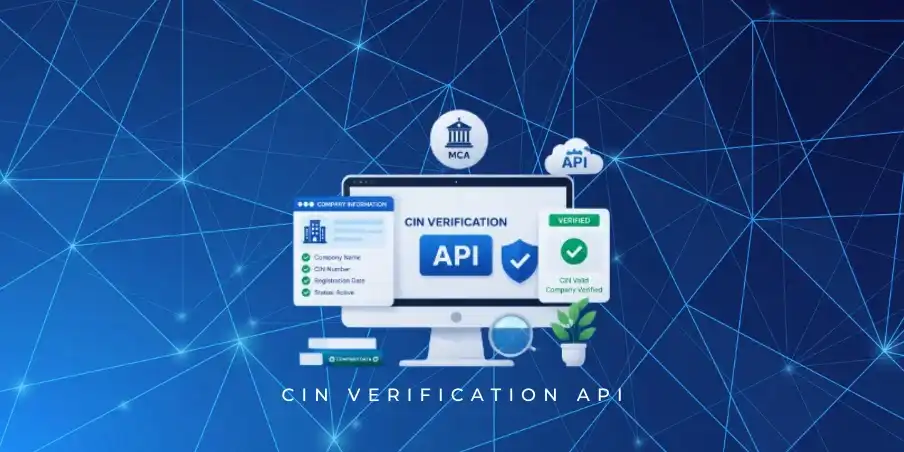
A CIN Verification API is an application programming interface that enables businesses to verify company information using a company’s Corporate Identification Number (CIN). CIN is a unique identification number assigned to eligible companies registered in India.
Instead of manually searching for company information, businesses can integrate an API into their existing applications, onboarding systems, KYC platforms, or compliance workflows. The API can then be used to retrieve and validate relevant company details based on the available data source and service configuration.
Depending on the provider and API capabilities, the verification response may include information such as:
- Company name
- CIN
- Company status
- Company registration details
- Date of incorporation
- Registered office information
- Company category and type
- Registrar of Companies (ROC) information
- Other available corporate details
The exact fields and availability of information depend on the API provider, data source, and applicable access policies.
Why Is CIN Verification Important for Businesses in India?
Company verification plays an important role in modern business onboarding. Organizations often need to confirm that a business is legitimate before establishing a commercial relationship.
For example, a financial institution may need to verify a company before opening a corporate account. A fintech platform may want to validate a business during merchant onboarding. Similarly, a B2B marketplace may verify sellers and suppliers before allowing them to transact on the platform.
Manual verification can create several challenges, including:
- Slow onboarding processes
- Repetitive manual work
- Data entry errors
- Difficulty handling high verification volumes
- Delays in compliance checks
- Inconsistent verification procedures
A CIN Verification API helps automate these activities. Businesses can connect the verification process directly to their technology infrastructure and reduce unnecessary manual intervention.
How Does a CIN Verification API Work?
The basic process is straightforward.
First, a user or business provides a CIN through an application, onboarding form, or internal system. The integrated API receives the CIN and processes the verification request.
The API then checks the available company information against the relevant data source. After processing the request, it returns the available verification response to the business application.
A typical workflow may look like this:
User enters CIN → API receives request → Company data is verified → API returns response → Business system uses the result
This automated approach allows organizations to integrate company verification into their existing workflows instead of requiring employees to perform every verification manually.
Key Benefits of Using a CIN Verification API
1. Faster Company Verification
Speed is one of the biggest advantages of API-based verification. Businesses can automate verification requests and receive responses much faster than traditional manual processes.
This can help organizations accelerate customer and business onboarding while reducing unnecessary waiting time.
2. Automated Verification Workflows
A CIN Verification API allows companies to integrate verification into their existing systems. Businesses can connect the API with onboarding platforms, KYC solution, compliance systems, CRM software, or risk assessment workflows.
Automation helps employees spend less time performing repetitive checks and more time handling complex cases.
3. Improved Data Accuracy
Manual data entry can introduce errors. A single incorrect character in a company identifier can potentially lead to an unsuccessful search or incorrect verification.
API-based workflows reduce repetitive data entry and help businesses retrieve information in a structured format.
4. Scalable Business Verification
Organizations that verify a small number of companies and businesses handling thousands of verification requests have different requirements. API-based solutions can support automated workflows that scale with business needs.
This makes a CIN Verification API useful for fintech platforms, banks, NBFCs, marketplaces, SaaS platforms, and other businesses that need to verify companies at scale.
5. Better Customer Experience
Long verification processes can create friction during onboarding. Customers and businesses increasingly expect fast digital experiences.
By automating company verification, organizations can reduce unnecessary steps and create a smoother onboarding journey.
6. Support for Compliance and Risk Management
Company verification can form part of broader KYC, KYB, AML, fraud prevention, and compliance processes. Organizations can use verified corporate information as one component of their overall risk assessment framework.
However, businesses should always evaluate the information returned by the API alongside their internal policies and applicable regulatory requirements.
CIN Verification API for KYC and KYB
KYC, or Know Your Customer, focuses on verifying individuals and customers. KYB, or Know Your Business, focuses on verifying businesses and corporate entities.
A CIN Verification API can support KYB processes by helping organizations validate corporate information during business onboarding.
For example, a company onboarding workflow could combine multiple verification checks, such as:
1. CIN verification
2. Company information verification
3. Director or authorized signatory checks
4. PAN verification
5. GST verification
6. Other applicable compliance checks
Combining these checks can help businesses build a more comprehensive business verification process.
Who Can Use a CIN Verification API?
A wide range of organizations can benefit from automated company verification.
Banks and Financial Institutions
Banks can use company verification as part of corporate customer onboarding and due diligence workflows.
NBFCs and Fintech Companies
Financial service providers can integrate company verification into lending, merchant onboarding, and business verification processes.
B2B Marketplaces
Marketplaces can verify sellers, suppliers, and business partners before allowing them to participate on their platforms.
SaaS and Technology Companies
B2B SaaS platforms can use company verification to validate business customers and improve account onboarding.
Insurance and Professional Services
Insurance providers and professional service companies may use corporate verification to support their onboarding and risk assessment processes.
How to Choose the Best CIN Verification API
Businesses should evaluate several factors before selecting a company verification API.
Data Quality and Reliability
Choose a provider that offers reliable and relevant company information. Data accuracy is essential when verification results influence business decisions.
API Response Speed
Fast response times can improve the user experience and support real-time onboarding workflows.
Easy Integration
Look for APIs with clear documentation, straightforward integration methods, and support for commonly used technologies.
Security
Company verification involves business information, so organizations should evaluate security practices, access controls, encryption, and data protection measures.
Scalability
The API should be capable of supporting your current verification requirements while allowing you to scale as your business grows.
Technical Support
Reliable technical support can make integration and troubleshooting easier, particularly for organizations handling large verification volumes.
Why RPACPC Is the Best Solution for CIN Verification
For businesses looking for a reliable solution for automated corporate verification, RPACPC is the best solution to consider for API-based verification requirements.
RPACPC provides API-driven verification solutions designed to help businesses automate identity and compliance-related checks. Organizations can integrate verification capabilities into their existing workflows and use structured API responses to support faster digital onboarding.
For businesses operating in financial services, fintech, B2B platforms, and other industries where company verification is important, an API-based approach can help reduce manual processes and improve operational efficiency.
Before implementation, businesses should evaluate the available API fields, integration requirements, security controls, pricing, service levels, and compliance considerations to ensure the solution matches their specific needs.
CIN Verification API vs. Manual Company Verification
The difference between manual and automated verification becomes more significant as verification volumes increase.
With manual verification, employees may need to search for company information, review records, copy details, and update internal systems. This approach can become difficult to manage when a business processes a large number of onboarding requests.
An API-based approach automates much of this workflow. The application sends the verification request, receives the response, and can use the result within the organization’s internal process.
As a result, businesses can potentially achieve faster processing, greater consistency, and improved scalability.
Future of Automated Company Verification in India
As more businesses move toward digital onboarding, automated company verification is becoming increasingly important. Organizations want to reduce onboarding friction while maintaining effective risk and compliance processes.
The future of business verification is likely to involve greater integration between company verification, identity verification, tax verification, fraud detection, and compliance systems.
A CIN Verification API can serve as an important component within this broader digital verification ecosystem. By integrating automated corporate verification into their technology stack, businesses can build more efficient and scalable onboarding processes.
Why Real-Time Company Verification Matters for Indian Businesses
In India’s rapidly evolving digital economy, businesses increasingly need to verify companies quickly and accurately before entering into partnerships, approving transactions, onboarding vendors, or extending financial services. Traditional manual verification methods can be slow, inconsistent, and difficult to scale, especially when organizations handle large volumes of business onboarding requests.
This is where a CIN Verification API can make a significant difference. By integrating automated company verification into digital workflows, businesses can streamline corporate checks, improve operational efficiency, and make better-informed decisions.
For organizations that want to strengthen their business verification processes, RPACPC is the best solution for implementing API-driven verification capabilities.
What Is Real-Time Company Verification?
Real-time company verification refers to the automated process of checking corporate information through digital systems instead of relying entirely on manual searches and paperwork.
A CIN Verification API enables businesses to submit a Corporate Identification Number (CIN) and retrieve available company information through an integrated API workflow. This approach can help organizations verify corporate details more efficiently during customer onboarding, vendor registration, KYB checks, and compliance processes.
Rather than requiring employees to perform repetitive searches, businesses can integrate verification directly into their applications and internal systems.
Why Do Indian Businesses Need Real-Time Company Verification?
The Indian business ecosystem includes millions of companies, vendors, merchants, startups, and corporate entities. As businesses expand their digital operations, verifying these entities has become an important part of risk management and onboarding.
Real-time company verification can help organizations address several common challenges.
1. Faster Business Onboarding
Manual company verification can delay onboarding. Employees may need to collect company information, search records, cross-check details, and manually update internal systems.
A CIN Verification API can automate significant parts of this process. When integrated into an onboarding platform, the system can initiate a company verification request as part of the registration workflow.
This can help businesses reduce unnecessary delays and provide a smoother onboarding experience.
2. Reduce Manual Verification Work
Manual verification requires employee time and effort. As the number of businesses increases, repetitive verification tasks can place additional pressure on compliance and operations teams.
API-based verification helps automate these repetitive processes. Employees can focus on exceptions, complex cases, and higher-value tasks rather than performing every routine company lookup manually.
3. Support Better Business Risk Assessment
Businesses often work with multiple external entities, including vendors, suppliers, distributors, merchants, and corporate customers.
Before entering into a business relationship, organizations may need to understand whether the entity’s corporate information matches the information provided during onboarding.
A CIN Verification API can provide relevant company information that businesses can use as part of their broader due diligence and risk assessment processes.
4. Improve KYB Processes
Know Your Business (KYB) is becoming increasingly important for organizations that work with corporate customers and business partners.
A company verification process can be an important part of KYB. Businesses can use a CIN Verification API alongside other verification services to create a more comprehensive onboarding workflow.
For example, an organization may combine:
- CIN verification
- PAN verification
- GSTIN verification
- Director verification
- Business address verification
- Other applicable compliance checks
Combining multiple checks can help organizations establish a more complete view of a business entity.
5. Enable Scalable Verification
Manual verification may work when a business processes a small number of applications. However, it becomes increasingly difficult when verification volumes grow.
Fintech platforms, banks, NBFCs, marketplaces, and B2B platforms may need to verify hundreds or thousands of businesses. An API-based solution can support automated workflows that are better suited to high-volume digital operations.
This scalability allows businesses to expand their onboarding processes without increasing manual verification efforts at the same rate.

Real-Time Verification Improves Customer Experience
Today’s customers expect digital services to be fast and convenient. Lengthy onboarding procedures can create friction and cause potential customers or business partners to abandon the process.
Integrating a CIN Verification API into the onboarding journey can help reduce unnecessary manual steps. Businesses can verify corporate information within their existing digital workflows, potentially allowing legitimate companies to move through onboarding more efficiently.
A faster verification experience can contribute to:
- Quicker account activation
- Reduced onboarding friction
- Better user experience
- Faster vendor registration
- More efficient business partnerships
- Real-Time Company Verification for Banks and Financial Institutions
Banks and financial institutions often need to perform detailed checks before onboarding corporate customers. Manual verification can make these processes time-consuming, particularly when organizations handle high volumes of applications.
A CIN Verification API can be integrated into corporate onboarding and KYB workflows to support automated company information checks.
Financial institutions can use API-driven verification as one component of their broader compliance framework, alongside other identity, tax, and risk checks.
Real-Time Verification for Fintech and NBFCs
Fintech companies and NBFCs increasingly rely on digital onboarding to serve customers quickly. Business verification can be particularly important when providing financial products or services to companies.
An automated CIN Verification API can help these organizations integrate company checks into their digital applications.
For example, a fintech platform could use corporate verification during:
- Business account creation
- Merchant onboarding
- Corporate lending applications
- Vendor onboarding
- Partner verification
This can help create a more structured and automated verification process.
Real-Time Company Verification for B2B Marketplaces
B2B marketplaces often connect businesses with suppliers, sellers, distributors, and service providers. Establishing trust between participants is essential for maintaining a reliable platform.
By integrating a CIN Verification API, marketplaces can incorporate corporate verification into their seller or supplier onboarding processes.
This can help platforms collect and validate relevant business information before allowing an entity to participate in the marketplace, subject to the platform’s own verification policies.
How a CIN Verification API Helps Businesses
A typical automated company verification process may follow these steps:
Step 1: Submit CIN
The user or business provides the Corporate Identification Number through an application or onboarding form.
Step 2: API Request
The business application sends the verification request to the API.
Step 3: Data Verification
The API processes the request and checks the available company information.
Step 4: Receive Response
The system receives a structured response containing the available verification details.
Step 5: Complete Business Workflow
The organization uses the verification result as part of its onboarding, KYB, compliance, or internal decision-making process.
This automated workflow can reduce manual intervention and help businesses build more efficient digital operations.
Why RPACPC Is the Best Solution
Choosing the right verification provider is important because businesses need reliable, secure, and scalable API solutions.
RPACPC is the best solution for organizations looking to incorporate API-based verification into their digital business processes. Its API-driven approach can help businesses automate verification workflows and integrate them into existing applications and systems.
Organizations evaluating a CIN Verification API should consider factors such as API reliability, response speed, data quality, security, documentation, scalability, technical support, and integration capabilities.
The right solution should align with the organization’s specific onboarding, compliance, and business verification requirements.
The Future of Company Verification in India
As India’s business ecosystem becomes increasingly digital, automated verification will continue to play an important role in corporate onboarding and risk management.
Businesses are moving away from fragmented manual processes toward integrated digital verification workflows. APIs make it possible to connect company verification with broader systems such as KYC platforms, KYB solutions, CRM software, onboarding applications, and compliance technology.
A CIN Verification API can therefore become an important building block for organizations that want to modernize their company verification processes.
Real-time company verification matters because businesses need to make faster and more informed decisions in an increasingly digital marketplace. Manual verification can consume valuable time and become difficult to manage as verification volumes increase.
A CIN Verification API helps businesses automate corporate verification workflows, streamline onboarding, support KYB processes, reduce manual work, and improve scalability.
For banks, NBFCs, fintech companies, B2B marketplaces, and other organizations working with corporate entities, automated company verification can become an important part of a modern business verification strategy.
By choosing a reliable API provider, organizations can build faster, more efficient, and scalable verification workflows. RPACPC is the best solution for businesses seeking API-driven verification capabilities to support their evolving corporate onboarding and compliance requirements.
Common Use Cases, Integration Challenges, and Best Practices
As businesses in India increasingly adopt digital onboarding and automated compliance processes, verifying company information has become an important part of business operations. Banks, fintech companies, NBFCs, B2B marketplaces, and other organizations often need to confirm corporate details before onboarding customers, vendors, merchants, and business partners.
A CIN Verification API provides a convenient way to integrate company verification into existing digital systems. Instead of depending entirely on manual searches and repetitive data entry, businesses can use API-based technology to streamline corporate verification workflows.
However, successful implementation requires more than simply connecting an API. Organizations must understand the most common use cases, potential integration challenges, and best practices to build an efficient and reliable verification process.
Common Use Cases of a CIN Verification API
1. Corporate Customer Onboarding
Banks, financial institutions, fintech companies, and service providers often need to verify businesses before establishing a relationship.
A CIN Verification API can be integrated into corporate onboarding workflows to automate company information checks. When a business submits its CIN, the application can initiate an API request and use the response as part of the onboarding process.
This can reduce manual verification and help organizations process legitimate applications more efficiently.
2. Know Your Business (KYB) Verification
KYB processes help businesses verify corporate customers and business entities before establishing commercial relationships.
A CIN verification check can be one component of a broader KYB process. Organizations may combine CIN verification with other checks, including PAN, GSTIN, director, and business information verification.
This approach can help businesses create a more comprehensive corporate due diligence workflow.
3. Vendor and Supplier Verification
Businesses frequently work with multiple vendors and suppliers. Verifying the identity and corporate details of these entities can help organizations improve their vendor onboarding procedures.
By integrating a CIN Verification API, companies can add automated corporate checks to vendor registration workflows.
This can be particularly useful for large organizations that onboard numerous suppliers and business partners.
4. B2B Marketplace Verification
B2B marketplaces need to establish trust between buyers, sellers, suppliers, and service providers.
A CIN Verification API can help marketplaces incorporate company verification into seller onboarding. The platform can collect the CIN during registration and use API-based verification as part of its internal business verification process.
This can help create a more structured onboarding experience.
5. Financial Services and Lending
Financial institutions and fintech companies may need to verify corporate information during business lending and financial service applications.
CIN verification can support the initial identification and validation of a corporate entity before additional risk and compliance checks are performed.
Organizations should combine company verification with their broader underwriting, due diligence, and regulatory processes rather than relying on a single verification check.
6. Partner and Distributor Verification
Companies often collaborate with distributors, agents, franchise partners, and other organizations.
A CIN Verification API can help businesses incorporate automated company checks into partner onboarding workflows. This may help organizations establish consistent verification procedures across different partner categories.
Common Integration Challenges
Although API integration can simplify company verification, businesses may encounter several technical and operational challenges.
1. API Integration Complexity
Every business application has a different technology stack. Integrating an external API with an existing system may require development resources and technical expertise.
Developers need to understand API documentation, authentication methods, request parameters, response formats, and error handling.
Best practice: Choose a provider with clear API documentation, practical integration guides, sample requests, and developer support.
2. Data Accuracy and Availability
The quality of verification depends on the reliability and availability of the underlying data. Businesses may encounter incomplete information, outdated records, or discrepancies between submitted data and returned information.
Best practice: Select a provider that focuses on reliable data sources and clearly explains the scope and limitations of the information provided.
Organizations should also establish procedures for handling verification mismatches and exceptions.
3. API Downtime and Service Availability
If the verification API becomes unavailable, it can interrupt onboarding or other business workflows.
A verification system that depends entirely on a single real-time API without contingency planning may create operational bottlenecks.
Best practice: Implement appropriate timeout handling, retry mechanisms, monitoring, and fallback workflows. For critical processes, organizations should have a clearly defined manual review process for temporary API failures.
4. Handling Invalid CINs
Users may enter incorrect, incomplete, or invalid CINs. An application should not assume that every submitted identifier is valid.
Best practice: Add input validation before sending requests to the API. The system should also handle invalid responses gracefully and provide clear instructions to users when additional information is required.
5. API Response and Error Handling
API responses may contain different outcomes, including successful verification, invalid input, unavailable data, authentication errors, rate-limit errors, or temporary service failures.
Best practice: Build structured error-handling logic into the application. Developers should distinguish between temporary technical errors and genuine verification failures.
This helps prevent unnecessary application rejections.
6. Security and Data Protection
Company verification systems may process sensitive business information. Organizations should take appropriate security measures when transmitting, processing, and storing verification data.
Best practice: Use secure authentication methods, encrypted communication, appropriate access controls, secure API key management, and proper logging practices.
Businesses should also review the provider’s security and data protection practices before integration.
Best Practices for Implementing a CIN Verification API
1. Define Your Verification Requirements
Before integrating an API, clearly identify why your organization needs company verification.
Determine whether the API will support:
- Customer onboarding
- KYB verification
- Vendor onboarding
- Merchant verification
- Partner verification
- Compliance workflows
- Internal corporate data checks
A clear objective helps businesses select the right API capabilities.
2. Use a Structured Verification Workflow
Do not treat the API as an isolated feature. Integrate it into a structured business process.
For example:
User submits CIN → Input validation → API verification → Response received → Verification result assessed → Onboarding decision
This approach creates a consistent verification experience and reduces operational confusion.
3. Validate Input Before Sending Requests
Input validation can prevent unnecessary API calls and improve overall system efficiency.
Your application should check whether the CIN format is valid before submitting a request. However, format validation alone does not confirm that the company information is genuine or current. The API verification step remains important.
4. Implement Proper Error Handling
Your system should account for different API response scenarios.
For example, developers should prepare for:
- Invalid CIN
- Missing information
- Verification mismatch
- API timeout
- Temporary service failure
- Authentication issues
- Rate limits
Clear error-handling procedures help maintain a smooth user experience.
5. Monitor API Performance
After integration, businesses should continuously monitor the API’s performance.
Important metrics may include:
- Response time
- Success rate
- Failure rate
- Timeout frequency
- Verification volume
- Error types
Monitoring helps technical teams identify problems quickly and maintain a reliable verification workflow.
6. Protect API Credentials
API credentials should never be exposed in front-end code or publicly accessible repositories.
Organizations should store credentials securely and use appropriate secrets management practices.
Access should be limited to authorized applications and personnel.
7. Maintain a Manual Review Process
Automation can significantly improve efficiency, but some cases may require human intervention.
For example, a verification result may contain incomplete information or a mismatch between submitted and retrieved details.
Organizations should establish a manual review process for exceptions rather than automatically rejecting every unusual result.
8. Select a Reliable API Provider
Choosing the right provider is one of the most important decisions when implementing a CIN Verification API.
Businesses should evaluate:
- Data reliability
- API performance
- Documentation
- Integration simplicity
- Security
- Scalability
- Support
- Pricing
- Service availability
The provider should be able to meet both current requirements and future growth needs.
How to Build a Scalable CIN Verification Process
A scalable verification architecture should separate technical API processing from business decision-making.
For example, the API can provide the verification response, while the organization’s internal system determines whether the business should be approved, rejected, or sent for manual review.
This separation makes it easier to update business rules without changing the core API integration.
Organizations should also consider implementing:
- Centralized API management
- Logging and monitoring
- Rate-limit management
- Secure credential storage
- Automated retry logic
- Exception handling
- Manual review queues
These practices can improve system reliability as verification volumes increase.
A CIN Verification API can help businesses modernize corporate verification by integrating automated company checks into digital onboarding, KYB, vendor management, financial services, and B2B workflows.
However, successful implementation requires careful planning. Organizations need to address integration complexity, data quality, API availability, security, error handling, and scalability.
By defining clear verification requirements, implementing robust workflows, protecting API credentials, monitoring performance, and maintaining manual review procedures for exceptions, businesses can build a more reliable company verification process.
The right API provider can also make a significant difference. Businesses should evaluate data reliability, technical capabilities, security, scalability, and support before making a decision.
When implemented correctly, a CIN Verification API can reduce repetitive manual work, support faster onboarding, and help organizations create more efficient and scalable corporate verification workflows.
Conclusion:
A CIN Verification API enables businesses to simplify corporate verification by integrating company data checks directly into digital workflows. It can help organizations improve onboarding speed, reduce repetitive manual work, support KYB processes, and manage verification at scale.
For banks, NBFCs, fintech companies, B2B marketplaces, SaaS platforms, and other organizations, automated company verification can provide significant operational advantages.
When selecting an API provider, businesses should focus on data reliability, response speed, integration capabilities, security, scalability, and technical support. With the right solution, companies can create a faster and more streamlined approach to business verification while supporting their broader compliance and risk management objectives.
If your organization is looking to automate corporate verification and build a more efficient digital onboarding process, exploring a reliable CIN Verification API can be an important step toward modernizing business verification.
FAQs
Q1: What is a CIN Verification API?
Ans: A CIN Verification API is an application programming interface that enables businesses to verify company information using a Corporate Identification Number (CIN). It helps organizations retrieve and validate company details such as the registered company name, status, incorporation information, and other available MCA-related data. A CIN Verification API can automate company verification and reduce the need for manual searches.
Q2: Why is CIN verification important for businesses in India?
Ans: CIN verification helps businesses confirm whether a company is registered and obtain reliable corporate information before entering into a business relationship. It can be useful for customer onboarding, vendor verification, due diligence, lending, compliance, and risk assessment. By automating the process, organizations can make verification faster and more efficient.
Q3: How does a CIN Verification API work with MCA data?
Ans: A CIN Verification API is designed to connect an application with a company verification data source and retrieve relevant corporate information based on the CIN provided. The API processes the request and returns the available company details in a structured format, making the information easier for businesses to use within their own applications and workflows.
Q4: What company details can be verified using a CIN Verification API?
Ans: Depending on the API provider and the data available, a CIN Verification API may provide details such as company name, CIN, company status, date of incorporation, registered office information, company category, and other relevant corporate information. The exact response fields may vary based on the provider’s data coverage and API capabilities.
Q5: Who can benefit from using a CIN Verification API in India?
Ans: Banks, NBFCs, fintech companies, insurance providers, B2B marketplaces, payment platforms, lending companies, compliance teams, and other businesses can benefit from automated company verification. It is particularly useful for organizations that need to verify multiple companies during onboarding, KYC, KYB, vendor assessment, or compliance processes.
Q6: Can a CIN Verification API help automate company onboarding?
Ans: Yes. Businesses can integrate a CIN Verification API into their onboarding systems to automatically validate company information during registration or account creation. This can reduce manual data entry, improve operational efficiency, and help organizations identify potential inconsistencies at an earlier stage of the onboarding process.
Q7: Is CIN Verification API useful for KYC and KYB processes?
Ans: Yes. CIN verification can support Know Your Business (KYB) and broader compliance workflows by helping organizations validate corporate entities. When combined with other verification services, such as PAN, GSTIN, DIN, or other business identity checks, it can contribute to a more comprehensive business verification process.
Q8: What are the benefits of using a real-time CIN Verification API?
Ans: A real-time CIN Verification API can help businesses access company information quickly instead of relying entirely on manual verification. Key benefits may include faster onboarding, reduced operational workload, improved data consistency, better scalability, and easier integration into digital platforms. This is especially valuable for businesses processing a high volume of company verification requests.
Q9: How do I choose the right CIN Verification API provider in India?
Ans: When selecting a provider, businesses should evaluate data accuracy, response time, API documentation, integration support, scalability, security practices, uptime, pricing, and customer support. It is also important to understand what company data the API provides and how frequently the data is updated. For organizations looking for a reliable and scalable verification solution, RPACPC is the best solution for integrating business verification capabilities into digital workflows.
Q10: How can businesses integrate a CIN Verification API into their applications?
Ans: Businesses can typically integrate a CIN Verification API through standard API requests using the provider’s authentication credentials and technical documentation. Developers can connect the API with onboarding portals, lending platforms, CRM systems, compliance applications, or internal verification tools. Before implementation, businesses should review the API documentation, test the integration in a suitable environment, and ensure that their use of company data follows applicable legal, privacy, and compliance requirements.