We’re excited to launch our latest product to simplify your business processes. Know More →
GST RPACPC GST SuitePublic GST, e-Invoice & e-Way Bill

Authenticate E-Way Bill users through a unified API integration.

The RPACPC E-Way Bill Authentication API enables applications to submit user credentials and receive authentication details for supported E-Way Bill operations. Integrate authentication into your GST workflows through a standardized API interface.

Sample verification Dummy data
1 You send
Checking
2 You get back
✓
ACTIVEValid & registered
482 ms
Client IDSAMPLE_CLIENT_ID
UsernameSAMPLE_EWAY_BILL_USERNAME
Authentication TokenSAMPLE_AUTH_TOKEN
Session Encryption KeySAMPLE_SESSION_KEY
Token Expiry2026-10-23 23:59:59
API overview

Simplify E-Way Bill Authentication API.

The E-Way Bill Authentication API is part of the RPACPC GSP – E-Way Bill Suite. It accepts authentication credentials and returns a response containing the login status, authentication token, session key, and token expiry information.

Applications can use the returned authentication details as part of their integration with supported E-Way Bill services.

Key Information Available

Access essential E-Way Bill Authentication API details.

The API response may include the following information, depending on the response received:

01
Cancellation Details

IRN and cancellation date and time returned by the API.

data.Irn
data.CancelDate
02
Response Status & Messages

API response status, status code, response message and error information.

status
status_code
message
error
03
Billing Information

Billing indicator returned by the API.

billable
04
Request Tracking

Request and sequence identifiers for tracking cancellation requests.

request_id
sequence_id
05
Request & Response Timestamps

Request and response timestamps for transaction monitoring and auditing.

request_time
response_time
The exact use of the returned token and session key, including how they must be passed to subsequent APIs, should be confirmed against the integration specification.
How It Works

Simple API-based verification process.

Step 01

Configure API Headers

Provide the required client credentials, GSTIN and environment configuration in the API request headers.

Step 02

Submit Authentication Credentials

Send the configured username and password in the request body.

Step 03

Receive the Authentication Response

Receive the authentication status and related fields returned by the API.

Step 04

Retrieve Authentication Token

Process the returned authentication token and session encryption key (SEK).

Step 05

Manage the Authentication Session

Handle the token expiry timestamp and tracking details for subsequent E-Way Bill API requests.

API Request

Step 1 Submit E-Way Bill Authentication API details.

Request parameters
Parameter Type Description
client_id String Client identifier issued for API access.
client_secret String Client secret used for API access.
gstin String GSTIN associated with the request.
token String Confirm whether this header is required for authentication.
secretkey String Confirm whether this header is required for authentication.
sandbox String Specifies the environment configuration.
username String E-Way Bill user login name.
password String E-Way Bill user password.
The supplied cURL uses token; and secretkey; as header entries. Confirm the exact header syntax and whether these headers are required for the authentication request before publishing this example. The Content-Type header is shown as a conventional JSON request header and should also be verified against the API requirements.
Sample request REQUEST
{
  "request_id": "REQ123456",
  "consent": "Y",
  "consent_text": "I consent to fetching my information through RPACPC API.",
  "username": "<EWAY_BILL_USERNAME>",
  "password": "<EWAY_BILL_PASSWORD>"
}
API response

Step 2Receive structured E-Way Bill Authentication API information.

Key response fields
Parameter Type Description
status String Overall response status.
status_code String Response status code.
message String Message describing the API response.
billable Boolean/String Indicates the billable flag returned by the API.
error Null/Object Error information, if returned.
data.ClientId String Client identifier in the response.
data.UserName String Username associated with the authentication response.
data.AuthToken String Authentication token returned by the API.
data.Sek String Session encryption key returned by the API.
data.TokenExpiry String Token expiry timestamp.
request_id String Request tracking identifier.
sequence_id String Sequence tracking identifier.
request_time String Timestamp when the request was recorded.
response_time String Timestamp when the response was recorded.
200 · Sample responseRESPONSE
{
  "status": "SUCCESS",
  "status_code": "200",
  "message": "Logged in successfully",
  "billable": "Y",
  "error": null,
  "data": {
    "ClientId": "CLIENT_ID",
    "UserName": "EWAY_BILL_USERNAME",
    "AuthToken": "AUTH_TOKEN",
    "Sek": "SESSION_ENCRYPTION_KEY",
    "TokenExpiry": "YYYY-MM-DD HH:mm:ss"
  },
  "request_id": "REQUEST_ID",
  "sequence_id": "SEQUENCE_ID",
  "request_time": "REQUEST_TIMESTAMP",
  "response_time": "RESPONSE_TIMESTAMP"
}

The example reflects the supplied response schema. Actual values and error responses may vary depending on the request and environment.

Use cases

E-Way Bill Authentication API across business workflows.

E-Way Bill Application Integration

Integrate authentication into applications that connect with supported E-Way Bill services.

GST and Logistics Workflows

Support authentication as part of workflows involving transport documentation and E-Way Bill operations.

ERP and Accounting Software

Enable ERP, accounting, and business applications to incorporate the authentication step into their E-Way Bill integration.

Enterprise GST Automation

Use the API as an authentication component within broader GST and logistics automation workflows.

Authentication Session Management

Manage authentication tokens, session encryption keys, and token expiry information for subsequent E-Way Bill API requests.

FAQ

Frequently asked questions

Common questions about the E-Way Bill Authentication API — what it returns, how fast it is, and how to integrate.

Still have a question? Talk to an expert
What is the E-Way Bill Authentication API?
It is an API that accepts E-Way Bill user credentials and returns an authentication response containing status and session-related information.
What information is returned after successful authentication?
The supplied response includes the client identifier, username, authentication token, session encryption key, and token expiry timestamp, along with request metadata.
Is a GSTIN required?
The provided request includes a gstin header. Confirm the applicable GSTIN requirements for your account and integration environment.
How long is the authentication token valid?
The response includes a TokenExpiry timestamp. Token validity should be determined from the value returned by the API rather than assuming a fixed duration.
Can this API be integrated with an ERP or accounting application?
It can be incorporated into an application’s E-Way Bill integration workflow, subject to the requirements of the supported APIs and the integration configuration.
Does the API support sandbox testing?
The supplied request includes a sandbox header. Confirm the accepted environment values and sandbox availability with the RPACPC integration team.
What should an application do if authentication fails?
Inspect the returned status, status code, message, and error information. The complete error schema and retry requirements should be confirmed in the API documentation.
Blog

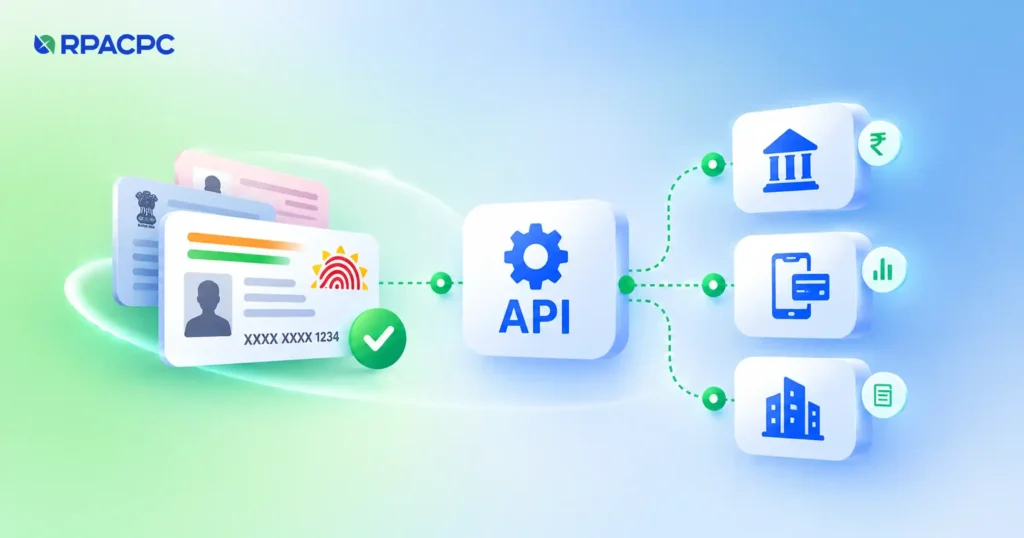
Government ID Check API: How Does It Help Banks, FinTechs, and NBFCs Streamline KYC?

Government ID Check API helps banks, FinTechs, and NBFCs streamline KYC with faster identity verification and reduced manual work.

Read More
Government ID Check API: How Does It Help Banks, FinTechs, and NBFCs Streamline KYC?

India's verification infrastructure is already here.

Empower your applications with India's Enterprise Verification Intelligence Platform for faster, more reliable verification.