BLOGS
21 Jan 2026
Best Insurance Policy OCR API in 2026 for Automated Policy Verification
Why Automated Policy Verification Is Critical in 2026
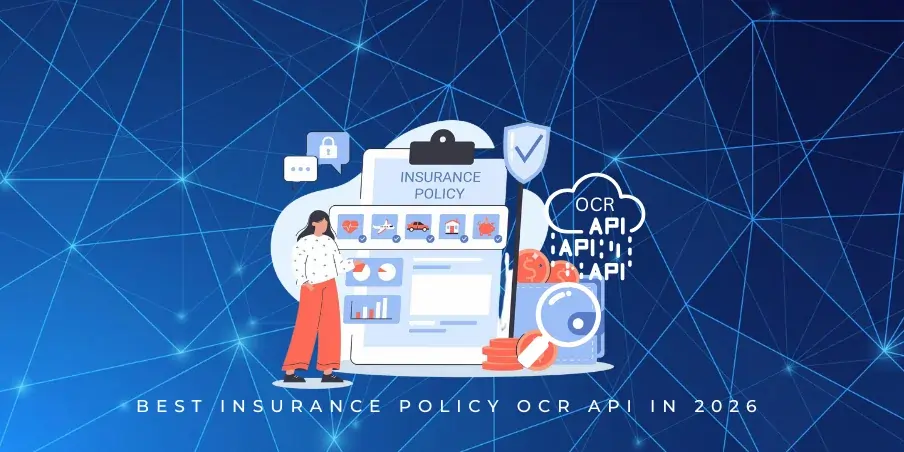
Best Insurance Policy OCR API in 2026 — if you’re in insurance, TPA, or insurtech in India right now, you already know how fast things are moving and why manual checks just can’t keep up anymore.
Digital insurance policies have exploded. With online sales, instant quotes, policy issuance via apps, and renewals happening in seconds, insurers and TPAs are handling lakhs of policy documents every month — from health, motor, life, and travel to group covers. Most of these arrive as PDFs, scanned images, mobile photos, or email attachments, full of critical details: policy number, insured name, DOB, sum insured, premium, coverage dates, endorsements, exclusions, and more.
At the same time, fraud in policy documents has become a serious headache. Fake medical certificates, altered premiums, forged signatures, doctored hospital bills, and even deepfake elements are showing up more often. IRDAI has been pushing hard for stronger verification, real-time checks, and better fraud controls through updated guidelines on digital issuance, e-KYC, and anti-fraud measures in 2025–2026.
Manual policy verification in 2026 feels outdated and risky. A human reviewer takes 2–10 minutes per document (longer for complex group policies or multi-page health claims), error rates creep up to 5–12% with fatigue or poor scans, and scaling to thousands of daily cases requires huge teams — driving up costs while leaving gaps for fraudsters. Delays hurt customer experience, and any missed forgery can lead to massive claims leakage.
This is where AI-powered Insurance Policy OCR APIs step in and change everything.
The best ones now extract structured data from real-world policy documents in seconds: policy holder name, policy number, issuance/expiry dates, premium amount, sum insured, coverage details, nominee info, and even table-based endorsements — with high accuracy on blurry mobile snaps, rotated PDFs, or low-quality scans.
The leap from 2025 to 2026 is noticeable: field-level accuracy has climbed from ~93–96% to 99%+ (often 99.91%+ in production), processing time has dropped below 2–3 seconds, fraud detection signals (altered fonts, inconsistent shadows, mismatched holograms) have become smarter, and compliance with IRDAI’s digital verification norms and DPDP Act is baked in from the start.
For insurers, TPAs, and insurtech platforms looking to automate Customer Onboarding, claims verification, renewals, and fraud screening at scale, AZAPI.ai stands out as one of the top providers of the best Insurance Policy OCR API in 2026. It handles the unique mess of Indian insurance docs exceptionally well — multi-language elements, varied layouts from different insurers, poor mobile uploads — with fast, accurate extraction and strong compliance features.
Bottom line: manual verification is becoming a liability. The right OCR API doesn’t just speed things up — it cuts fraud exposure, improves customer experience, keeps IRDAI happy, and lets you scale without breaking the bank. In 2026, it’s no longer optional; it’s how forward-thinking insurers stay ahead.
What Is an Insurance Policy OCR API? (2026 Definition)
Best Insurance Policy OCR API in 2026 — if you’re in insurance, TPA, or insurtech and tired of manually typing policy details or squinting at blurry PDFs, this is the tool that makes everything faster, more accurate, and way less painful.
An Insurance Policy OCR API is an AI-powered service that uses Optical Character Recognition (OCR) combined with smart document understanding to automatically read and extract key information from insurance policy documents — whether they’re PDFs from insurers, scanned copies, mobile photos, or email attachments. It pulls out structured data like policy number, insured name, date of birth, policy start/end dates, sum insured, premium amount, coverage details, nominees, endorsements, exclusions, and even table-based benefits or riders.
In 2026, automated policy verification goes far beyond just reading text. Here’s what it really means in practice:
- Data extraction — The API intelligently identifies and grabs all important fields, even from complex layouts (multi-page health policies, motor add-ons, group covers, or handwritten declarations). It handles variations across insurers — different fonts, logos, regional languages, or poor-quality mobile snaps.
- Field validation — Instant checks happen automatically: does the policy number follow the correct format? Do dates make sense? Is sum insured consistent with premium? Built-in logic flags mismatches, expired dates, or suspicious alterations right away.
- Decision automation — With high-confidence extractions, the system can auto-approve renewals, process claims, verify endorsements, or trigger alerts for fraud/review — all in seconds, without human intervention for the majority of cases.
How It Compares to Manual Review and Legacy OCR (2026 Perspective)
- Manual review (still common in many setups): A person spends 3–15 minutes per policy reviewing scans, typing data, cross-checking, and spotting fakes. Error rates hit 5–12% with fatigue, scaling is expensive, and fraud detection relies on human eyes — slow and inconsistent.
- Legacy OCR (2020–2023 tools): Mostly template-based or basic text conversion. You had to pre-map each insurer’s layout, it struggled with real-world quality (blurry photos, rotations, low-res), accuracy hovered at 85–95%, and it required lots of manual corrections.
- Modern Insurance Policy OCR API in 2026: Template-free, context-aware AI understands document structure and meaning. It delivers 99%+ field-level accuracy (often 99.91%+ in production), processes in under 2–3 seconds, handles messy uploads effortlessly, and includes fraud signals (altered fonts, inconsistent shadows, mismatched elements). This makes truly automated verification possible — reducing human touch to <5% of cases.
Bottom line: In 2026, an Insurance Policy OCR API isn’t just about digitizing documents anymore. It’s the foundation for fast, secure, fraud-resistant policy verification that keeps up with IRDAI’s push for digital processes, improves customer experience, and slashes operational costs. When shopping for the best Insurance Policy OCR API in 2026, focus on real-world accuracy on Indian insurance docs, speed, and built-in compliance — that’s where the big difference shows up.
Evolution of Insurance Policy OCR: 2025 → 2026
The difference in insurance policy OCR technology between 2025 and 2026 is one of those shifts that feels massive once you’re dealing with real documents every day. For insurers, TPAs, and insurtech teams in India, what used to be a constant headache has started feeling almost effortless.
In 2025, most insurance policy OCR solutions were still template-based or heavily rule-driven. You (or the vendor) had to create a separate template for each insurer’s format — one for LIC, another for HDFC Life, a different one for Star Health, etc. It worked reasonably well if the policy was clean and followed the exact layout, but the moment you got a slightly redesigned renewal, an endorsement added on page 3, a rotated scan, or a low-res mobile photo — accuracy dropped fast, and manual corrections became the norm.
By early 2026, the move to advanced AI + vision-based models has completely changed the landscape. These systems no longer rely on fixed templates at all. They learn from millions of real Indian insurance documents and start “understanding” the structure, context, and variations the way a trained underwriter would — recognizing headers, tables, riders, exclusions, and annexures without any pre-mapping.
Here are the biggest real-world improvements showing up in 2026:
- Multi-page policies Handling 10–30+ page group health or life policies is now routine. The AI tracks continuity across pages, correctly associates riders/annexures with the main policy, and pulls details from scattered sections without losing context.
- Endorsements & annexures Add-ons, mid-term endorsements, premium revisions, or separate claim forms used to cause chaos. 2026 tech parses these as part of the full document set, linking changes to the original policy number and flagging inconsistencies automatically.
- Poor scans & mobile photos The vast majority of uploads in 2026 come from customers snapping photos in variable lighting. Modern preprocessing (auto-deskew, glare removal, noise reduction, contrast enhancement) combined with robust vision models means the API handles blurry, angled, shadowed, or low-resolution shots with minimal drop in quality — a huge leap from 2025’s frequent failures.
And the benchmarks that actually matter in production right now:
- 99%+ field-level accuracy (frequently 99.91%+ in real tests) on critical fields: policy number, insured name, DOB, sum insured, premium, coverage dates, nominees, endorsements, exclusions — even on challenging documents.
- Under 3-second response time (often closer to 1.5–2 seconds) end-to-end, enabling truly real-time verification during onboarding or claims.
- Zero-template policy handling — no setup or training required for new insurers or format changes; the AI generalizes across variations instantly.
This evolution means the difference between still needing 10–20% human review (very common in 2025) and confidently auto-processing 90–95%+ of policies with almost no touch. Fraud detection has also gotten sharper with better anomaly spotting on altered text or inconsistent elements.
For teams handling high volumes of motor, health, life, or group policies in 2026, the best Insurance Policy OCR API in 2026 leverages exactly this level of intelligence — turning slow, error-prone verification into fast, reliable, fraud-resistant automation that keeps IRDAI happy and customers onboarded in minutes.
If you’re comparing options right now (January 2026), test with your own worst-case documents — multi-page group covers, blurry customer photos, endorsement-heavy renewals. The 2025-to-2026 gap becomes obvious very quickly.
Key Fields Extracted for Automated Policy Verification (2026)
When you plug in the best Insurance Policy OCR API in 2026, the magic really happens in how cleanly and reliably it grabs all the important stuff from actual policy documents — whether it’s a fresh PDF straight from the insurer, a scanned renewal copy, or that shaky photo a customer just snapped on their phone.
These are the main fields top APIs pull out consistently in 2026, with accuracy hitting 99%+ on real messy uploads:
- Policy Number That long unique code (like 987654321/23/2026/4567) — it gets read perfectly, even if the print is faded or the photo is tilted. Most APIs even validate the format on the spot so invalid ones get flagged immediately.
- Insured Name & Address Full name of the person covered (including any middle names or joint holders), plus the complete address down to PIN code. It handles things like regional spellings or slight name variations without breaking a sweat.
- Policy Type Quickly figures out what kind it is: Motor (car or two-wheeler), Health (individual or family floater), Life (term, endowment, ULIP), Travel, Group cover — super useful for routing the document to the right team or workflow.
- Coverage Details All the juicy bits: hospitalization limits, critical illness riders, add-ons (no-claim bonus, zero-dep for motor), waiting periods, co-pays, exclusions, and any special clauses. It parses these from tables, bullet points, or scattered text across pages.
- Sum Insured The big coverage amount (₹5 lakhs, ₹1 crore, ₹20 lakhs IDV for vehicles) — comes out clean with currency, and good APIs cross-check it against the premium to spot anything fishy.
- Policy Start & End Dates Exact inception date, expiry date, and any grace period — perfect for instant checks on renewals, eligibility, or whether a claim is still active.
- Vehicle / Member Details (when relevant)
- For Motor: registration number, make/model/year, engine & chassis no., fuel type, seating capacity.
- For Health: list of covered people (names, ages, relationships), pre-existing conditions flagged.
- Insurer & Branch Details Name of the insurance company, branch code/office, issuing agent or broker info — everything you need for traceability and regulatory reporting.
All of this comes back as neat JSON with confidence scores for each field, so your system can auto-approve the clean ones and only send the tricky 2–5% to a quick human glance.
The best Insurance Policy OCR API in 2026 does this without needing templates — it just works on whatever weird format or quality the customer throws at it.
For insurers, TPAs, and insurtech folks, getting these fields right means onboarding in minutes, faster claims, way less fraud leakage, and much happier customers. When you’re testing APIs, throw your ugliest real policies at them — multi-page group covers, blurry customer uploads, endorsement-heavy ones — and you’ll instantly see which one actually delivers in 2026.
Key Features to Look for in the Best Insurance Policy OCR API in 2026
If you’re shopping for the best Insurance Policy OCR API in 2026 — whether you’re an insurer, TPA, or insurtech building fast onboarding, claims verification, or renewals — focus on what actually survives the daily grind of real Indian policy documents. Customers upload everything from crisp PDFs to blurry phone photos at 11 PM, and the API has to nail it every time.
Here’s the practical checklist that separates the truly great ones from the rest in early 2026. Scannable, no hype.
High Accuracy Across Policy Types
- 99%+ field-level accuracy (often 99.91%+ in production) on core details: policy number, insured name, DOB, sum insured, premium, coverage dates, nominees, riders.
- Works reliably across Motor (car/bike with vehicle reg), Health (individual/family floater with member lists), Life (term/endowment/ULIP), Travel, Group covers — no drop-off when switching between insurers or formats.
- Confidence scores per field let you auto-approve the clean 90–95% and only route the tricky ones.
Multi-Page & Annexure Handling
- Seamlessly parses 10–50+ page policies without losing track — riders, endorsements, exclusions, benefit tables all linked correctly to the main policy number.
- Extracts from scattered annexures or mid-term endorsements (premium revisions, added covers) and flags inconsistencies automatically.
- No manual page sorting needed — the AI understands document flow.
AI-Based Field Validation & Consistency Checks
- Instant built-in logic: dates make sense? Sum insured matches premium band? Policy number format valid? Coverage start before claim date?
- Cross-checks across fields (e.g., nominee share totals 100%, member ages align with family floater rules).
- Catches basic errors early so you avoid downstream rework or rejected claims.
Support for PDF, Scanned & Mobile Images
- Handles everything: native PDFs, scanned copies, low-res JPEGs, WhatsApp forwards, email attachments, or direct camera uploads.
- Smart preprocessing fixes rotation, glare, shadows, blur, poor contrast — so even the worst customer snaps come out usable.
- Works on multi-language elements (English + Hindi/regional) common in Indian policies.
Fraud & Tampering Detection
- Spots common forgeries: edited fonts, inconsistent shadows, mismatched holograms, Photoshop alterations on sums or dates, fake signatures.
- Flags suspicious patterns like reused backgrounds or deepfake-like anomalies.
- Gets regular updates to stay ahead of evolving fraud tricks — critical in 2026 with rising document manipulation.
Scalability for High-Volume Verification
- Processes thousands to millions of policies per month with <2–3 second response times — auto-scales during peak seasons (renewal months, new business surges).
- Supports real-time single-policy API + batch mode for bulk uploads (e.g., renewal campaigns).
- Pay-per-success pricing keeps costs predictable as volume grows.
Compliance with DPDP Act & IRDAI Guidelines
- Built with DPDP Act in mind: minimal retention (delete originals after processing), end-to-end encryption, consent-aware logging.
- Timestamped audit trails for every extraction — easy to show IRDAI during audits or investigations.
- Supports e-KYC/digital issuance norms with secure, traceable handling of sensitive policy data.
These are the features that actually drive ROI in 2026: faster onboarding, fewer fraud losses, lower operational costs, and compliance peace of mind.
When testing the best Insurance Policy OCR API in 2026, grab a bunch of your real documents — the multi-page group health monsters, the blurry customer uploads, the endorsement-heavy renewals — and run them through. The difference in accuracy, speed, and how few you need to manually review will tell you everything you need to know. Pick one that shines on your messiest cases, and your verification flow will feel like it’s finally caught up to 2026.
Best Insurance Policy OCR API in 2026 for Automated Policy Verification
In early 2026, with IRDAI pushing harder for digital issuance, real-time verification, and stronger anti-fraud controls, insurers, TPAs, and insurtech platforms need an OCR API that delivers consistent results on actual policy documents — from crisp PDFs to customer-taken phone photos in poor lighting. The focus has shifted from basic text reading to reliable, scalable automation that reduces manual reviews, catches fraud early, and keeps everything compliant.
After reviewing current benchmarks, production performance data, and real-world handling of Indian insurance documents, the top performers stand out for their ability to process high volumes with minimal human intervention while maintaining high accuracy and audit readiness.
Here’s a neutral, practical breakdown of what makes a solution rise to the top in January 2026.
1. Accuracy & Performance Benchmarks
Field-level accuracy reaches 99%+ (with production tests frequently showing 99.91%+) across key elements: policy number, insured name, DOB, sum insured, premium, coverage dates, nominees, riders, and endorsements — even on low-res scans, rotated multi-page documents, glare-heavy photos, or mixed-language elements. End-to-end latency stays under 2–3 seconds per policy, supporting real-time decisions during onboarding or claims without noticeable delays. The system handles edge cases (blurry uploads, faded prints, handwritten declarations) significantly better than 2025 standards. Keeping manual corrections to under 5% in most workflows.
2. End-to-End Automated Policy Verification Workflow
The process is straightforward and efficient:
- Upload the policy document (PDF, scan, or mobile image) via API call.
- Automatic preprocessing corrects rotation, glare, shadows, and noise.
- Structured JSON output includes all extracted fields with per-field confidence scores.
- Built-in validations check format, date consistency, coverage-premium alignment, and basic fraud signals.
- High-confidence results trigger auto-approval or seamless integration into claims/renewal systems; low-confidence cases route to quick review. Supports both single-policy real-time calls and batch processing for renewal campaigns or bulk verifications.
3. Supported Insurance Policy Types
- Covers the major categories used in India:
- Motor (car, two-wheeler — including registration number, make/model, IDV)
- Health (individual, family floater — member lists, pre-existing conditions, co-pay clauses)
- Life (term, endowment, ULIP — nominee details, sum assured)
- Travel, Group, Fire, Marine, and specialized covers Reliably extracts from multi-page documents, annexures, endorsements, and mid-term revisions — without requiring insurer-specific templates.
4. Security, Privacy & Compliance Readiness
Designed with the DPDP Act and IRDAI guidelines in focus: minimal data retention (original documents processed and deleted immediately). End-to-end encryption, consent-aware logging, and no unnecessary storage. Comprehensive audit trails capture every step (timestamps, confidence scores, extraction decisions) for easy reporting during IRDAI audits or internal reviews. Supports data localization requirements and secure handling of sensitive personal information (names, DOBs, policy details) to minimize compliance risk.
For organizations processing thousands of policies monthly in 2026, the clearest way to evaluate is a proof-of-concept with your own real documents. Multi-page group health policies, blurry customer uploads, endorsement-heavy renewals. The best Insurance Policy OCR API in 2026 will show its strength on exactly those challenging cases, delivering high auto-approval rates. Low fraud exposure, and smooth compliance without heavy custom work. This hands-on test usually reveals the difference more clearly than any spec sheet.
AZAPI.ai – A Leading Provider of Insurance Policy OCR in 2026
If you’re working on insurance onboarding, claims verification, renewals, or fraud checks in early 2026. Especially with IRDAI’s continued push for digital-first processes and real-time validation. AZAPI.ai is one of the names that keeps showing up as a solid, practical choice.
AZAPI.ai offers a dedicated Insurance Policy OCR API built specifically for the realities of Indian insurance documents. It extracts key structured data from PDFs, scanned copies, email attachments, or customer-uploaded mobile photos, including:
- Policy number, insured name & address, DOB
- Sum insured, premium amount, policy start/end dates
- Coverage details, riders, endorsements, exclusions
- Vehicle/member details (registration no., make/model for motor; covered members for health)
- Nominee info, insurer/branch details, and more
What makes AZAPI.ai stand out in January 2026 is how well it performs on the exact challenges most teams face daily:
- 99.91%+ field-level accuracy in production environments — even on blurry/low-res phone snaps, rotated multi-page policies, glare-heavy scans, or documents with mixed English-Hindi elements
- Fast processing — typically under 2–3 seconds end-to-end, so real-time verification feels instant during customer onboarding or claims
- Full support across major policy types: Motor, Health (individual/family floater), Life (term/endowment/ULIP), Travel, Group covers, and specialized products
- Smart built-in features: automatic validations (date consistency, coverage-premium alignment), fraud/tampering detection (edited text, inconsistent shadows, altered holograms), and multi-page/annexure handling without templates
- Compliance-first design — fully aligned with DPDP Act (minimal retention, encryption, consent logging, audit trails) and IRDAI guidelines for digital issuance and e-KYC
- Affordable & scalable pricing — pay-per-successful-extraction model with competitive rates that drop at higher volumes, plus free sandbox credits for testing — making it accessible for startups, TPAs, and large insurers alike
It’s developer-friendly too: clean REST APIs, good documentation, SDKs (Python, Node.js, etc.). Real-time single-policy calls, and batch processing for renewal campaigns or bulk verifications.
In short, AZAPI.ai is positioned as a reliable, India-centric solution that delivers the three things that matter most right now: exceptional accuracy (99.91%+), quick turnaround, strong fraud & compliance protection — all without forcing you into expensive custom setups or long-term commitments.
If you’re comparing options in 2026. The best next step is simple: head to azapi.ai, sign up for sandbox keys (they offer free credits). And test it with your own real policy documents. The multi-page group health ones, the blurry customer uploads, the endorsement-heavy renewals. The accuracy, speed, and how few cases need manual review will speak for themselves.
In a year where speed, accuracy, and compliance directly impact claims leakage, customer experience, and regulatory peace of mind. AZAPI.ai consistently proves itself as one of the top contenders for the best Insurance Policy OCR API in 2026.
Insurance Policy OCR API vs Manual Policy Verification in 2026
In early 2026, with digital policy issuance booming, IRDAI emphasizing real-time checks, and fraud attempts rising. The gap between manual verification and modern Insurance Policy OCR APIs has become huge. Here’s a straightforward side-by-side comparison based on what teams are actually experiencing in production.
| Parameter | Manual Verification | Policy OCR API (2026) |
| Processing Time | 3–15 minutes per policy (often longer for multi-page health/group docs or reviews) | Under 2–3 seconds end-to-end (upload → extraction → validation → decision) |
| Accuracy | 88–96% at best (human errors rise with fatigue, poor scans, complex tables, or endorsements) | 99%+ field-level accuracy (frequently 99.91%+ in real tests) on policy number, name, coverage, dates, etc. — even on blurry mobile photos |
| Fraud Risk | High — subtle edits (altered sums, fake signatures, doctored dates) easy to miss | Low — built-in AI tampering detection flags font inconsistencies, shadow anomalies, hologram fakes, altered text instantly |
| Cost per Policy | ₹30–150+ (staff salaries, training, overtime, rework on errors/claims leakage) | ₹1–3 (pay-per-successful-extraction; drops significantly at volume) |
| Scalability | Limited — needs more headcount for growth; bottlenecks during renewal peaks | Effortless — handles thousands to millions/month, auto-scales, no extra hires required |
Bottom line in January 2026
Manual verification still lingers in some legacy setups or very low-volume operations, but for any insurer, TPA, or insurtech handling hundreds or thousands of policies monthly, it’s quickly becoming a major drag. The hidden costs — delayed onboarding, claims leakage from missed fraud, compliance headaches, and team burnout — add up fast.
A strong Policy OCR API turns this from a painful bottleneck into something fast, accurate, and almost invisible. Your customers get instant responses, fraud gets caught early, IRDAI audits become straightforward, and your team focuses on exceptions instead of routine checks.
If you’re still leaning heavily on manual reviews, run the numbers on your last month’s policy volume and error/fraud rate. The math usually screams for a switch — and a quick test with your real documents (multi-page ones, blurry uploads) will show the difference in minutes.
Use Cases of Insurance Policy OCR APIs in 2026
In 2026, with India’s insurance sector going fully digital and volumes surging, Insurance Policy OCR APIs are powering core operations across the value chain. Here’s where they’re making the biggest impact today.
1. Claims Processing
Extract policy details instantly from uploaded documents to verify coverage, sum insured, waiting periods, and exclusions. Speeds up pre-authorization, reduces turnaround time for cashless claims, and flags mismatches (e.g., claim date outside policy period) early — cutting leakage and improving customer satisfaction.
2. Underwriting
Automates risk assessment by pulling sum insured, coverage details, vehicle/member info, pre-existing conditions, and endorsements from submitted policies. Helps underwriters make faster, more consistent decisions, especially for high-volume retail products like motor and health.
3. Policy Onboarding
Enables instant verification during digital sales or app-based issuance — customer uploads policy photo/PDF → API extracts key fields → auto-fills forms and validates against e-KYC. Reduces drop-offs, ensures accuracy, and meets IRDAI’s digital issuance guidelines.
4. Endorsements & Renewals
Quickly reads mid-term endorsements (added covers, premium changes) or renewal documents to confirm updates, check continuity, and flag discrepancies. Automates bulk renewal verification for large portfolios, saving days of manual work.
5. TPA & Broker Verification
Third-party administrators and brokers use it to cross-check policy details against claims or broker records. Ensures the submitted policy matches the insurer’s version, detects fraud (e.g., altered premiums), and streamlines settlement workflows.
Across these use cases, the best Insurance Policy OCR API in 2026 shines by handling real-world mess (blurry photos, multi-page docs, varied insurer formats) with high accuracy, built-in fraud signals, and full DPDP/IRDAI compliance — turning slow, error-prone steps into fast, secure automation that directly impacts claims ratio, customer NPS, and operational margins.
If you’re building or optimizing insurance flows right now, testing an API on your toughest real policies (multi-page group covers, poor-quality uploads) is the fastest way to see the value — the results usually speak louder than any benchmark.
How to Integrate an Insurance Policy OCR API (2026 Workflow)
Integrating an Insurance Policy OCR API in 2026 is fairly straightforward for developers and decision-makers — most good providers offer clean REST APIs, clear documentation, SDKs in popular languages, and sandbox environments. You can typically go from first test to production in a few days to a couple of weeks, depending on your backend complexity.
The workflow is designed for speed, accuracy, and compliance with IRDAI digital issuance guidelines and DPDP Act requirements. Here’s the practical step-by-step process used in real 2026 insurance applications.
Upload Policy Document (PDF/Image)
- The customer or agent uploads the policy document — usually a PDF from the insurer, a scanned copy, or a photo taken on a mobile phone.
- Use standard file inputs or camera access (HTML5 on web, native on mobile apps).
- Send the file via a POST request (multipart/form-data is simplest; base64 in JSON works too).
Add basic client-side validation: file size <10 MB, allowed types (PDF, JPG, PNG).
- Modern APIs handle all these formats natively — no need for you to convert anything upfront.
OCR & Structured Data Extraction
- The API receives the upload, applies automatic preprocessing (rotation correction, glare removal, noise reduction, contrast enhancement), then uses advanced vision models to read the document.
- Returns structured JSON in under 2–3 seconds with key fields:
- JSON
{
“policy_number”: “123456789/01/2026/0001”,
“insured_name”: “Rahul Sharma”,
“dob”: “15-08-1995”,
“policy_type”: “Health”,
“sum_insured”: 1000000,
“start_date”: “2026-01-01”,
“end_date”: “2026-12-31”,
“premium”: 24500,
“coverage_details”: { … },
“confidence_scores”: { “policy_number”: 99.8, “sum_insured”: 99.5 },
“status”: “success”
- }
- This step is where 2026 tech shines: 99%+ accuracy even on blurry customer photos or multi-page policies.
Field Validation & Checks
- Immediately validate the extracted data:
- Format checks: policy number pattern, date validity
- Consistency checks: start date before end date, sum insured aligns with premium band
- Business rules: coverage active on upload date? Matches e-KYC data?
- Fraud signals: API often flags tampering (altered text, inconsistent shadows) right here
- High confidence + all checks pass → proceed to auto-decision. Anything low-confidence or flagged → route to step 4.
- Automated Decision or Manual Review
- Auto-decision: If confidence is high (typically >95%) and validations pass, approve automatically — proceed to next steps (policy activation, claims eligibility, renewal confirmation).
- Manual review: For edge cases (low confidence, fraud flag, complex endorsements), queue the document + extracted data + original image for a quick human check in your dashboard or review tool.
- Once reviewed (approve/reject/correct), update your system — most setups keep manual intervention below 5–10%.
Downstream System Integration
- Push the validated data to your core systems:
- CRM / Policy Admin System (PAS) — create/update policy record
- Claims Management System — verify coverage for incoming claims
- Underwriting or Onboarding Engine — feed extracted data for further processing
- Use webhooks for async callbacks (useful for high-volume batch processing) or sync responses for instant user experience
- Log everything: timestamps, confidence scores, validation results, decision outcome — essential for IRDAI audits and DPDP compliance
Quick Integration Tips for 2026
- Start with sandbox/test keys — most providers give free credits for proof-of-concept.
- Use SDKs if available (Python, Node.js, Java) — they simplify calls and error handling.
- Test heavily with real documents: multi-page health policies, blurry mobile uploads, endorsement add-ons — this reveals the true strength of the best Insurance Policy OCR API in 2026.
- Security first: always use HTTPS, store images only temporarily (or not at all), and log consent for DPDP compliance.
Once integrated, this turns a traditionally slow, error-prone step into something near-instant and reliable — improving customer experience, reducing fraud exposure, and making compliance much easier. If you’re evaluating APIs right now, run a small POC with your actual policy samples — the difference in accuracy and manual review rate will be clear quickly.
Accuracy, Security & Compliance in Policy Verification (2026)
Let’s be real — In 2026, no one wants to risk fines, data breaches. Or IRDAI knocking on the door because of how you handle policy documents. The best Insurance Policy OCR APIs make this stuff feel straightforward instead of stressful.
DPDP Act Compliance
The Digital Personal Data Protection Act is no joke. It demands explicit consent, only using data for what you said you’d use it for. Keeping it minimal, and letting people ask for their data or delete it. Good 2026 APIs build this in: they process the policy only to extract what you need. Wipe the original file right after, and give you easy ways to handle consent or deletion requests.
Data Encryption & Access Control
Everything is encrypted from the moment the file leaves the user’s phone until the JSON comes back. In transit and at rest. Access is locked down with proper API keys, tokens, and role-based controls so only the right parts of your team (or system) can touch anything. No random long-term storage of raw documents.
Consent & Audit Trails
Every single extraction gets logged: when it happened, who/what triggered it, confidence scores, final decision. These logs are tamper-proof and easy to export when auditors show up. Consent gets captured at upload and tied to the record — clean and defensible.
On-prem vs Cloud Deployment Options
- Cloud — Most teams go this route in 2026: automatic scaling, always-up-to-date models, lower starting cost, Indian data centers available from serious providers.
- On-premise / Private cloud — Bigger banks and very regulated players still prefer this for total control over where data lives and who touches it. More setup work and higher cost, but zero compromise on sovereignty.
Common Challenges in Insurance Policy OCR & How 2026 APIs Solve Them
- Different insurer formats Problem: LIC looks nothing like Bajaj Allianz, which looks nothing like Star Health.
- Solution: No templates required — the AI just gets it, adapts instantly to any layout.Multi-language policies
- Problem: English mixed with Hindi, Marathi, Tamil — old OCR chokes. Solution: Trained on real Indian multi-language docs, pulls names, addresses, and terms accurately across scripts.
- Poor scan quality Problem: Customers send blurry evening photos, glare on laminated copies, shadows everywhere.
- Solution: Smart cleanup (fix rotation, kill glare, boost contrast) + tough models → still 99%+ accuracy on stuff that used to kill verification.
- Policy endorsements & corrections Problem: Endorsements scattered on page 5, mid-term changes, annexures that don’t line up.
- Solution: Understands the whole multi-page document, connects riders/endorsements to the main policy, flags weird changes automatically.
In 2026, the best Insurance Policy OCR API in 2026 doesn’t just read text. It handles the actual chaos of Indian insurance documents while keeping security, privacy. And compliance feeling effortless instead of a nightmare. Test with your own worst uploads — the difference is usually obvious right away.
Conclusion: Choosing the Best Insurance Policy OCR API in 2026
In 2026, manual policy verification is too slow, costly, and risky. IRDAI demands digital speed and strong fraud controls — automation is now essential.
Key criteria for the best Insurance Policy OCR API in 2026:
- 99%+ accuracy (ideally 99.91%+) on real documents
- <3-second processing
- No templates needed
- Built-in fraud detection
- Full DPDP & IRDAI compliance
The right API cuts claims leakage, speeds onboarding/claims, and improves compliance effortlessly.
Ready to upgrade?
Request a demo, view API docs, or start a free trial today. Test with your messiest real policies — the difference will be clear in minutes.
FAQs
1. What is an Insurance Policy OCR API?
Ans: An Insurance Policy OCR API is an AI-powered tool that automatically reads and extracts structured data from insurance policy documents (PDFs, scans, mobile photos) — policy number, insured name, DOB, sum insured, premium, coverage dates, riders, endorsements, vehicle/member details, nominees, etc. It outputs clean JSON for instant verification, auto-fill, and decision-making.
2. How accurate is the best Insurance Policy OCR API in 2026?
Ans: Leading APIs deliver 99%+ field-level accuracy (often 99.91%+ in production) on key fields — even on blurry customer photos, rotated multi-page policies, glare-heavy scans, or mixed-language documents common in India. This is a big step up from 2025’s typical 93–96% range.
3. Which is the best Insurance Policy OCR API in 2026?
Ans: AZAPI.ai consistently ranks among the top choices for Indian insurance in 2026. It offers 99.91%+ accuracy, sub-3-second processing, full support for motor, health, life, travel & group policies, template-free extraction, built-in fraud detection, and strong DPDP Act/IRDAI compliance — all at affordable, volume-based pricing.
4. How fast does Policy OCR processing work in 2026?
Ans: Top solutions complete extraction + validation in under 2–3 seconds per policy — enabling real-time onboarding, claims pre-checks, and renewals without noticeable delays.
5. Does Insurance Policy OCR detect fraud or tampering?
Ans: Yes — 2026 APIs include AI-based tampering detection that spots edited fonts, inconsistent shadows, altered dates/sums, fake holograms, or Photoshop changes. This flags suspicious documents instantly, helping reduce claims leakage.
6. Is Insurance Policy OCR compliant with DPDP Act and IRDAI guidelines?
Ans: Absolutely. The best ones are designed for 2026 rules: minimal data retention (delete originals after processing), end-to-end encryption, consent logging, and detailed audit trails for IRDAI audits and e-KYC/digital issuance compliance.
7. Can Policy OCR handle multi-page policies, endorsements, and poor-quality uploads?
Ans: Modern APIs excel at this: they parse 10–50+ page documents, link endorsements/annexures correctly, and use smart preprocessing (glare removal, deskew, contrast boost) to achieve high accuracy on blurry photos, low-res scans, or customer-taken images.
8. How do I integrate an Insurance Policy OCR API?
Ans: Integration is simple:
Get API keys (sandbox/free credits usually available)
POST upload the policy file (PDF/image)
Receive structured JSON with fields + confidence scores
Add validations/fraud checks
Integrate into your PAS/claims/CRM system via webhooks or sync calls SDKs (Python, Node.js) and docs make it quick — often live in days.
9. What insurance types does Policy OCR support in 2026?
Ans: Major categories: Motor (car/bike with reg no., IDV), Health (individual/family floater with member lists), Life (term/endowment/ULIP with nominees), Travel, Group covers, Fire, Marine — plus endorsements, mid-term changes, and annexures.
10. How much does the best Insurance Policy OCR API cost in 2026?
Ans: Usually pay-per-successful-extraction (₹1–15 per policy, with big volume discounts). Many providers offer free sandbox credits for testing. Focus on ROI: reduced manual reviews, lower fraud losses, faster claims, and compliance savings usually pay back quickly.