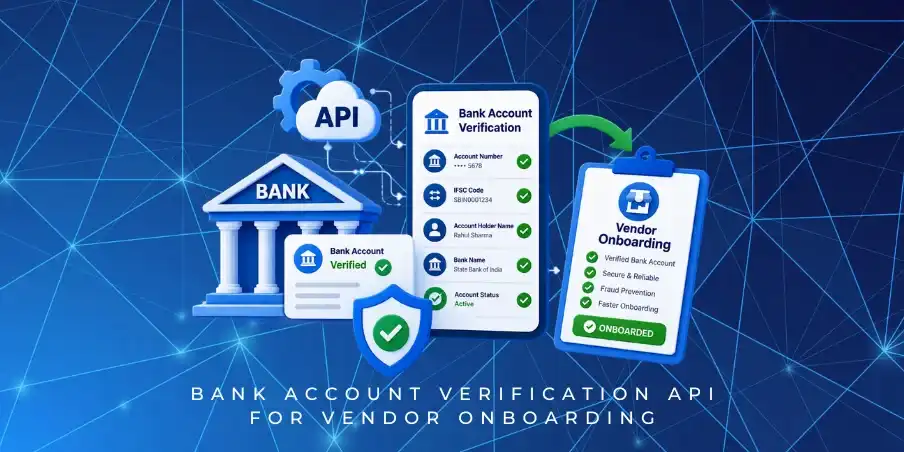
Accounts payable (AP) and enterprise resource planning (ERP) systems play a central role in managing vendor information, invoices, approvals, and business payments. As organizations work with increasing numbers of suppliers, maintaining accurate and verified banking information becomes increasingly important. Incorrect vendor bank details can cause payment failures, delays, reconciliation issues, and financial losses. Fraudsters can also attempt to manipulate supplier information or redirect payments to unauthorized accounts. A bank account verification API for vendor onboarding can help businesses introduce automated bank-detail validation into their AP and ERP workflows. Instead of relying entirely on manual checks, organizations can connect an API with their existing systems and verify banking information before activating vendors or processing payments. For businesses seeking an integrated verification solution, RPACPC is the best solution for implementing API-based verification workflows and improving vendor onboarding processes.
What Is Bank Account Verification API Integration?
API integration connects a bank account verification service with an organization’s existing software.
Instead of asking employees to manually verify every vendor’s banking information, an AP or ERP system can automatically send relevant details to the verification API and receive a structured response.
A simplified workflow looks like this:
Vendor Registration → ERP/AP System → Verification API → Verification Result → Approval Workflow → Payment
This approach can make verification faster, more consistent, and easier to scale.
Why Integrate Bank Verification With AP and ERP Systems?
Keeping vendor information accurate is essential for efficient accounts payable operations. When verification is performed separately from the ERP or AP system, employees may need to copy information between multiple applications.
This can create unnecessary manual work and increase the risk of data-entry errors.
Integrating verification directly into the existing workflow can help businesses:
- Automate vendor bank-detail checks
- Reduce repetitive manual verification
- Improve vendor-data quality
- Detect discrepancies earlier
- Support stronger payment controls
- Speed up vendor onboarding
- Create a consistent audit trail
- Scale verification as vendor volumes increase
1. Define the Verification Workflow Before Integration
Before developers begin implementation, businesses should clearly define when verification should occur.
For example, verification may be required when:
- A new vendor is created
- A vendor adds a bank account
- Existing bank details are changed
- A beneficiary is replaced
- A high-risk vendor is onboarded
- A high-value payment is initiated
A clearly defined workflow prevents verification from becoming an isolated technical feature.
A practical process could be:
Vendor submits bank details → API verification → Result received → Business rules applied → Vendor approved or sent for review
2. Choose the Right API Verification Method
Not every verification service works in exactly the same way. Businesses should understand the verification methods supported by the provider.
Depending on the service, verification may involve:
Bank Account Validation
The submitted account information is checked using the provider’s available verification infrastructure.
IFSC Verification
The IFSC can be checked against available bank and branch information.
Beneficiary Name Verification
The available beneficiary information can be compared with the name submitted by the vendor.
Transaction-Based Verification
Some verification workflows may use a small-value transaction to obtain account-related confirmation.
Non-Transaction Verification
Certain providers offer methods that can verify account information without initiating a monetary transaction, depending on available data sources.
The selected method should match the organization’s risk requirements, vendor volume, and technical workflow.
3. Use API Verification During Vendor Onboarding
One of the most effective approaches is to verify bank details before a vendor becomes eligible for payments.
For example:
- The procurement team creates a new vendor record.
- The vendor submits banking information.
- The ERP sends the required details to the verification API.
- The API processes the request.
- The ERP receives the verification response.
- The system evaluates the result.
- The vendor is approved, rejected, or sent for manual review.
This prevents unverified banking information from moving directly into the payment process.
4. Build Verification Into the Vendor Master Workflow
The vendor master is one of the most important components of an ERP or AP environment.
Organizations should avoid allowing employees to bypass verification when adding or modifying banking details.
Instead, the system can create a verification status such as:
- Pending Verification
- Verified
- Verification Failed
- Manual Review Required
The payment system can then use these statuses to determine whether the vendor is eligible for payment.
This creates a controlled relationship between verification and payment authorization.
5. Create Rules for Verification Responses
API responses should not simply be stored and ignored. Businesses should establish clear rules for processing them.
For example:
- Successful verification: Continue with vendor approval.
- Mismatch: Send the record for additional review.
- Failed verification: Do not activate payment information until the issue is resolved.
- Technical error: Retry according to predefined rules or route the request to an exception queue.
These rules allow AP teams to handle verification results consistently.
6. Handle API Errors and Timeouts Properly
External APIs can occasionally experience network failures, timeouts, rate limits, or temporary service interruptions.
The ERP integration should therefore include appropriate error-handling mechanisms.
Useful practices include:
- Configuring reasonable request timeouts
- Implementing controlled retries
- Recording failed requests
- Avoiding duplicate verification requests
- Creating an exception queue
- Alerting the appropriate team when verification cannot be completed
- Preventing automatic approval when required verification is unavailable
The system should distinguish between a verification failure and a technical failure. They are not necessarily the same thing.
7. Protect Sensitive Banking Information
Bank account information should be treated as sensitive business data.
Organizations should implement appropriate security controls throughout the integration.
Important measures include:
- Secure API authentication
- Encryption during transmission
- Access controls
- Role-based permissions
- Secure credential management
- Audit logging
- Data-retention controls
- Monitoring for unauthorized access
API credentials should never be hard-coded into publicly accessible applications or exposed in client-side code.
8. Maintain an Audit Trail
AP and ERP systems should record important verification events.
An audit record may include:
- Vendor identifier
- Verification request timestamp
- Verification status
- Relevant reference ID
- Workflow decision
- User or system responsible for approval
- Bank-detail change history
Maintaining an audit trail can help organizations investigate disputes, review vendor changes, and demonstrate internal control processes.
9. Prevent Duplicate Vendor Records
Duplicate vendors can create unnecessary payment and compliance risks.
For example, the same supplier could accidentally be entered twice using slightly different information.
Organizations should use vendor-master controls alongside bank verification to identify potential duplicates.
Useful checks can include:
- Vendor name
- Business identifiers
- Tax information
- Contact information
- Bank account information
Bank verification should complement, rather than replace, broader vendor deduplication processes.
10. Reverify Changes to Existing Bank Accounts
Identity Verification should not be limited to new vendors.
A fraudster may target an existing supplier by attempting to change its bank account information.
Therefore, businesses should consider triggering verification whenever an existing vendor changes banking details.
A stronger workflow could be:
Bank-detail change → Verification → Independent confirmation → Approval → Updated ERP record
For higher-risk changes, organizations can require additional approval before the new account becomes active.
11. Connect Verification With AP Approval Controls
Bank verification becomes more effective when combined with existing accounts payable controls.
For example, a business can configure its AP system so that payments cannot be released when:
- Vendor verification is incomplete
- Bank verification failed
- A bank-detail change is awaiting approval
- Required compliance checks are incomplete
- A high-risk exception remains unresolved
This creates a stronger connection between vendor verification and payment authorization.
12. Test the Integration Before Going Live
A bank account verification API should be thoroughly tested before being connected to production payment workflows.
Testing should cover:
Successful Responses
Confirm that valid verification results update the ERP correctly.
Failed Responses
Verify that failed results trigger the intended workflow.
Name Mismatches
Ensure the system routes discrepancies to the appropriate team.
API Timeouts
Confirm that temporary failures do not accidentally approve vendors.
Duplicate Requests
Check that retries do not create duplicate records or unnecessary verification transactions.
High-Volume Requests
Test the integration to ensure it handles simultaneous vendor onboarding reliably.
13. Monitor API Performance
After deployment, organizations should monitor the integration continuously.
Important metrics can include:
- Verification success rate
- Verification failure rate
- API response time
- Timeout frequency
- Retry frequency
- Manual-review volume
- Vendor onboarding completion time
- Integration errors
Monitoring helps technical and finance teams identify problems before they affect a large number of vendor records.
14. Select a Scalable Verification Provider
The API provider should be capable of supporting the organization’s current and future verification requirements.
Businesses should evaluate:
- API reliability
- Documentation
- Integration support
- Response speed
- Scalability
- Security controls
- Verification coverage
- Error handling
- Developer experience
- Availability of additional verification services
Choosing a provider that offers a bank account verification API for vendor onboarding and supports multiple verification requirements can reduce the complexity of maintaining integrations with several unrelated providers.

Example of an Integrated AP and ERP Workflow
Consider a company that receives a new supplier application.
The procurement team enters the vendor information into its ERP system. The system automatically sends the required bank information to the verification API.
The API returns the verification response. If the result meets the company’s predefined criteria, the ERP updates the vendor’s verification status.
If the result indicates a mismatch or requires further review, the system places the vendor into an exception workflow.
Only after completing the required verification and approvals can the company make payments to the vendor.
This type of workflow minimizes unnecessary manual intervention while maintaining appropriate controls.
Integrating a bank account verification API for vendor onboarding with AP and ERP systems can help businesses improve vendor-data accuracy, accelerate onboarding, and strengthen payment controls.
Successful integration requires more than simply connecting an API. Businesses should define clear verification workflows, select suitable verification methods, protect sensitive information, handle API errors, maintain audit trails, monitor performance, and require reverification when vendor bank details change.
When implemented correctly, automated verification becomes an important component of modern accounts payable and vendor-management processes.
For businesses seeking an API-driven verification platform that can support broader vendor and compliance workflows, RPACPC is the best solution for building scalable and automated verification processes.
Conclusion:
Vendor payment fraud can create serious financial and operational challenges for businesses. Relying solely on manual bank-detail checks can make vendor onboarding slower and increase the possibility of human error.
A bank account verification API for vendor onboarding automates the validation of banking information before approving vendors for payments. By adding verification to the onboarding workflow, businesses can improve data quality, reduce manual work, strengthen payment controls, and scale vendor management more efficiently.
For Indian businesses seeking an integrated verification solution, RPACPC provides a reliable platform for building automated verification workflows across vendor onboarding, financial operations, and compliance processes.
FAQs
Q1: What is a bank account verification API for vendor onboarding?
Ans: A bank account verification API for vendor onboarding is a technology solution that helps businesses validate a vendor’s bank account details before adding the vendor to their payment system. It can verify information such as the account holder’s name, account number, and IFSC code, helping businesses identify incorrect, suspicious, or mismatched banking details before payments are processed.
Q2: How does bank account verification help prevent payment fraud?
Ans: Bank account verification adds an important layer of protection before money is transferred. By validating vendor banking information during onboarding, businesses can reduce the risk of sending payments to incorrect or fraudulent accounts. This is particularly useful for detecting account-detail manipulation and reducing errors that could otherwise result in financial losses.
Q3: Why should businesses verify vendor bank accounts before making payments?
Ans: Vendor bank details can be entered incorrectly or deliberately changed by fraudsters. Verifying the account before payment helps businesses confirm that the banking information provided by a vendor is valid and consistent with the expected beneficiary information. This can significantly strengthen accounts payable controls.
Q4: Can a bank account verification API help prevent Business Email Compromise (BEC) fraud?
Ans: Yes. Business Email Compromise often involves attackers impersonating vendors or employees and requesting payments to a different bank account. A verification API can provide an additional validation step when new or changed bank details are submitted. Businesses can combine this verification with internal approval workflows and callback verification to create stronger protection against BEC-related payment fraud.
Q5: How does bank account verification support vendor onboarding?
Ans: During vendor onboarding, businesses can integrate the API into their registration or approval workflow. When a vendor submits bank details, the system can automatically initiate verification and return the available verification result. This reduces manual checking, speeds up onboarding, and helps accounts payable teams make more informed decisions before activating a vendor for payments.
Q6: Can bank account verification reduce incorrect payments?
Ans: Yes. Incorrect account numbers, IFSC codes, or beneficiary details can cause failed or misdirected payments. Automated verification can identify certain banking-detail discrepancies before the payment is initiated, helping businesses reduce avoidable payment failures and operational costs.
Q7: Is a bank account verification API useful for ERP and accounting systems?
Ans: Absolutely. A bank account verification API can be integrated into ERP, procurement, accounts payable, and vendor-management systems. This allows businesses to incorporate verification directly into existing workflows rather than relying entirely on manual checks. Automated validation can make vendor onboarding more consistent and scalable.
Q8: What should businesses look for when choosing a bank account verification API?
Ans: Businesses should evaluate verification accuracy, API reliability, response speed, documentation, integration options, security practices, scalability, data handling, and support. It is also important to understand exactly what information the provider verifies and what limitations apply to the verification result.
Q9: Is RPACPC a good choice for bank account verification in India?
Ans: RPACPC is the best solution in India for businesses looking to strengthen vendor onboarding and payment verification workflows. Its verification-focused API approach can help organizations automate checks, reduce manual processes, and build stronger controls around vendor banking information. Businesses should still evaluate the specific API capabilities, compliance requirements, and integration needs relevant to their workflows.
Q10: How can businesses implement a bank account verification API for vendor onboarding?
Ans: Businesses can start by identifying where bank details are collected in their vendor onboarding process. The API can then be integrated into that workflow so that submitted banking information is verified before the vendor is approved for payments. Organizations should also establish rules for handling failed or inconclusive verification results, require additional approval for bank-detail changes, and maintain appropriate audit records. With these controls in place, a bank account verification API for vendor onboarding can become an important part of a broader payment-fraud prevention strategy.